
Angle Between a Line and a Plane

The Angle Between a Line and a Plane Refers to the Angle Formed Between the Direction of the Line and the Normal Vector of the Plane at Their Point of...
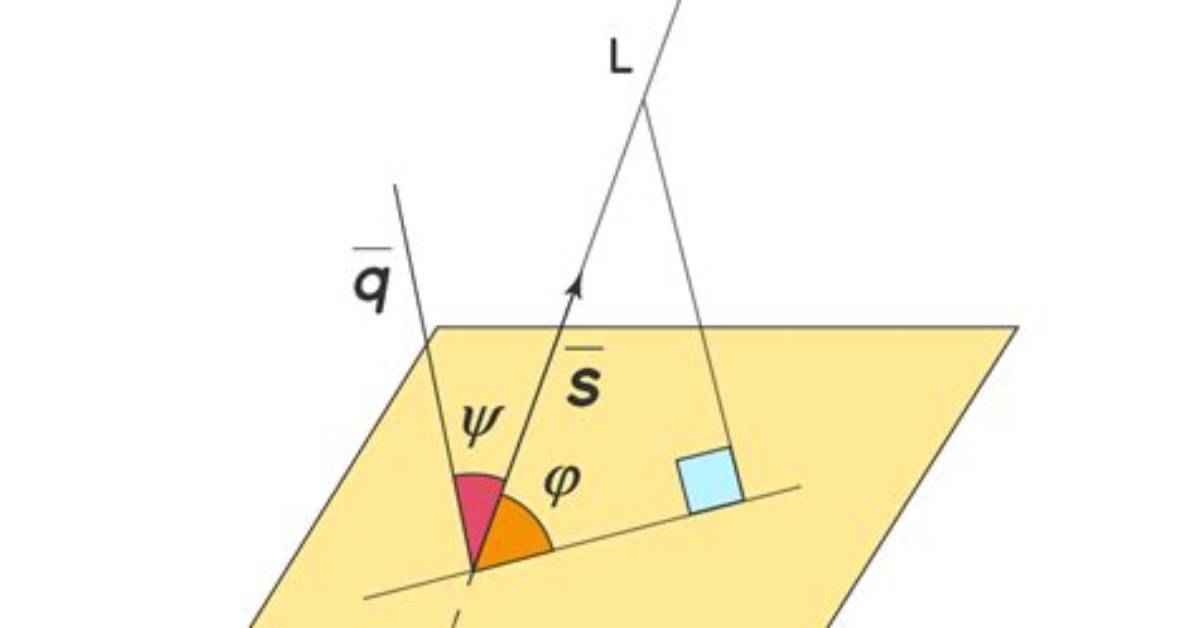
The angle between a line and a plane refers to the angle formed between the direction of the line and the normal vector of the plane at their point of intersection. This angle is measured in three-dimensional space and can be calculated using vector operations.
To find the angle between a line and a plane, you'll need the direction vector of the line and the normal vector of the plane. Here are the steps to calculate it:
Step 1: Determine the direction vector of the line:
The direction vector of a line is a vector that points in the direction of the line. If you have two points A and B on the line, you can find the direction vector AB by subtracting the coordinates of A from the coordinates of B: AB = B - A.
Step 2: Determine the normal vector of the plane:
The normal vector of a plane is a vector that is perpendicular to the plane's surface. If you know the equation of the plane in the form Ax + By + Cz + D = 0, the normal vector N = (A, B, C).
Step 3: Calculate the dot product of the direction vector and the normal vector:
The dot product of two vectors A = (a1, a2, a3) and B = (b1, b2, b3) is given by A · B = a1 * b1 + a2 * b2 + a3 * b3.
Step 4: Calculate the magnitude of the direction vector and the normal vector:
The magnitude of a vector A = (a1, a2, a3) is given by |A| = sqrt(a1^2 + a2^2 + a3^2).
Step 5: Calculate the angle between the line and the plane:
The angle θ between the line and the plane is given by the formula: θ = arccos((AB · N) / (|AB| * |N|)).
Note: The angle between a line and a plane is always acute, meaning it is between 0 and 90 degrees.
If the line and the plane are given in different formats or you need to find the angle between a specific line and a specific plane, you may need to adjust the calculations accordingly.
How do you Find the Angle Between a Plane and a Line?
To find the angle between a plane and a line, follow these steps:
Step 1: Identify the plane and the line.
You need to have the equation of the plane and the equation of the line in three-dimensional space.
Step 2: Find the direction vector of the line.
For the line, you will need a direction vector (a vector parallel to the line). If the equation of the line is in the form of parametric equations (x = x0 + at, y = y0 + bt, z = z0 + ct), then the direction vector of the line is given by the coefficients of t (i.e., the vector a, b, c).
Step 3: Find the normal vector of the plane.
For the plane, you will need a normal vector (a vector perpendicular to the plane). If the equation of the plane is in the form Ax + By + Cz + D = 0, then the coefficients A, B, and C give the normal vector of the plane (i.e., the vector A, B, C).
Step 4: Calculate the angle.
The angle θ between the plane and the line can be found using the dot product formula:
cos(θ) = (n . l) / (|n| * |l|)
where:
n = Normal vector of the plane
l = Direction vector of the line
. = Dot product operator
The dot product of two vectors n and l is given by:
n . l = n_x * l_x + n_y * l_y + n_z * l_z
And the magnitude (length) of a vector v = (v_x, v_y, v_z) is given by:
|v| = √(v_x^2 + v_y^2 + v_z^2)
Step 5: Find the angle.
Once you have calculated cos(θ), you can find the angle θ using the inverse cosine function (arccos) if you are looking for the angle in radians. If you need the angle in degrees, you can convert it using the formula: degrees = radians * (180 / π).
Remember to use a calculator to compute the inverse cosine or any other trigonometric functions.
If the angle obtained is acute (between 0 and 90 degrees), it means the line intersects the plane. If the angle is obtuse (between 90 and 180 degrees), it means the line is not intersecting the plane. If the angle is 90 degrees, the line is perpendicular to the plane.
Must Read
What is the Formula for a Line and a Plane?
The formula for a line in three-dimensional space (3D) is typically represented in parametric form as follows:
Line:
If the line passes through a point P0 (x0, y0, z0) and has a direction vector d = <a, b, c>, then any point P(x, y, z) on the line can be parameterized as:
x = x0 + at
y = y0 + bt
z = z0 + c*t
Here, 't' is the parameter that varies, and it allows you to find any point on the line by plugging in different values of 't'. The direction vector d determines the slope and direction of the line.
On the other hand, the formula for a plane in 3D can be expressed in different forms, but one common way is the equation of a plane in scalar equation form:
Plane:
If the plane is determined by a point P0 (x0, y0, z0) lying on the plane and two non-parallel direction vectors v = <a, b, c> and w = <d, e, f>, then any point P(x, y, z) on the plane satisfies the equation:
a*(x - x0) + b*(y - y0) + c*(z - z0) = 0
and
d*(x - x0) + e*(y - y0) + f*(z - z0) = 0
In vector form, the equation of the plane can be written as n · r = n · r0, where n is the normal vector of the plane (perpendicular to the plane) and r0 is the position vector of a point on the plane.
It's important to note that these formulas for lines and planes apply to three-dimensional space. In two-dimensional space (2D), the formulas for lines and planes are simpler since there's only one coordinate to consider.
Sophia analyzes international trade, startup ecosystems, retail transformation, and supply chain logistics for modern digital publications.
