
Cold vs Hot Data Storage: What’s the Difference?

The Usage of Temperature Terms Hot and Cold to Distinguish Between Storage Options Originates in the Physical Ways We Have Stored Data for Decades. Items...
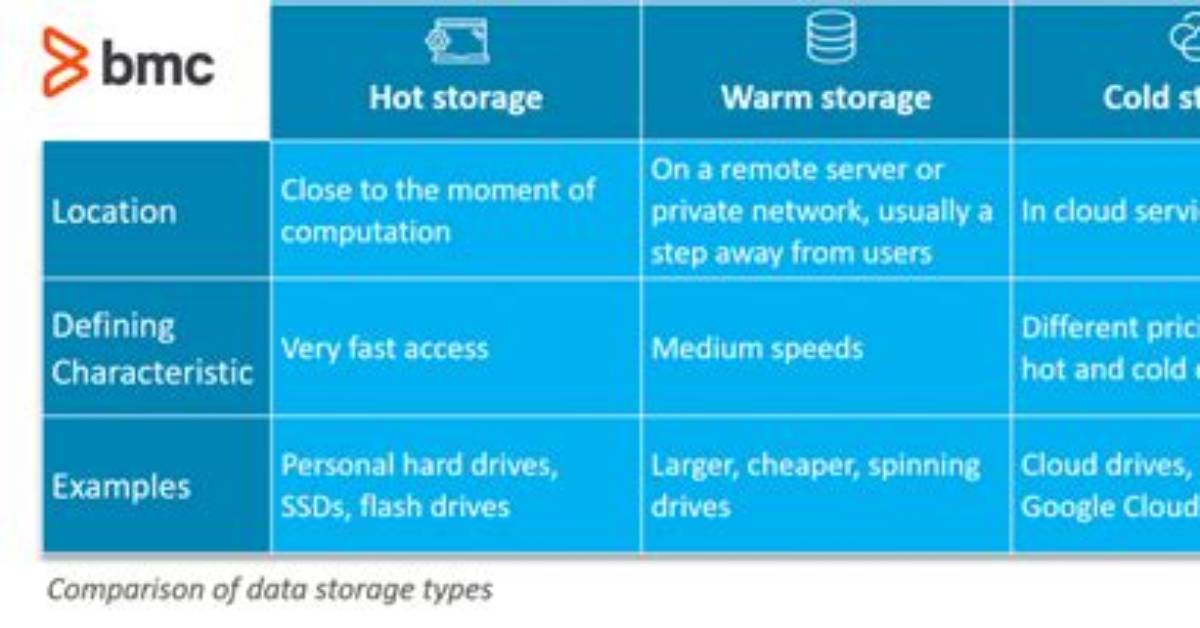
The usage of temperature terms hot and cold to distinguish between storage options originates in the physical ways we have stored data for decades. Items closer to the data center were accessed more regularly, and were located, literally, in storage facilities that were hot.
Items further from the data center had slower loading times, so it became the place to store data you needed to access much less frequently. This type of storage was done differently from hot storage—typically either using old drives or drives that were turned off entirely. These storage types did not generate the kind of heat the other storage facilities created.
Let’s take a look at data storage, including how the cloud is affecting how we store and compute data.
Cloud vs on-prem storage: hot, warm, cold
Which storage is hot and which storage is cold can vary depending on the kind of storage architecture you use:
- In a distributed system that uses edge devices, hot storage can serve as both computational memory and storage for each individual edge device.
- Pure cloud services can offer both hot and cold computational memory and storage, with any off-cloud device using cold storage.
Here’s a breakdown of the traditional hot vs cold categories, with warm data storage emerging as a third type:
Must Read
When to use hot storage
All data that you need to be able to access immediately must be placed in hot storage. This can include data that is:
- Known to change
- Used for customer query purposes
- Used in any current projects
Hot storage requires immediate and reliable access. For example, Amazon and Google’s services have a 99.95% availability, while Azure offers up to a 99.99%. Data that comes in from a hot storage system can be called “data streams”. Many sophisticated systems process the flow of data as it flows in from your storage.
Data transfer speeds depend on one primary thing: How many routes does the data pass through to get from its host to its destination? Data that is processed closest to its source will be fastest. Data that has to travel over a few different networks and arrive on a developer’s laptop can take longer to access.
For example, if data is hosted in Google Storage and the user wishes to retrieve and process that storage through another Google server or within a Google Colab notebook, they should find their process speeds to be fairly quick. If the data is fetched from Google Storage and being transferred to a local external hard drive, the data has to pass through many more routes. That data is also dependent on network speeds and read/write speeds to write the data to a new hard drive.
In machine learning projects, data is read multiple times and needs to be provided to the ML model quickly, so it should be located in hot storage. This data can be on a drive on the modeler’s laptop or on an external drive. For large companies with notoriously large datasets can require immediate access to many terabytes or petabytes, and a cloud service provider can help manage their hot storage options. Once the data has been used, or replaced and ready to be retired, the data can be stored in cold storage for a team’s data versioning.
Robert Thorne covers electric vehicle innovations, autonomous driving systems, global mobility trends, and automotive engineering developments.
