
Data Engineer vs Data Scientist: What’s the Difference?

The Data Engineer Equips the Business with the Ability to Move Data from Place to Place, Known as Data Pipelines. Data Engineers Provide Data to the Data...
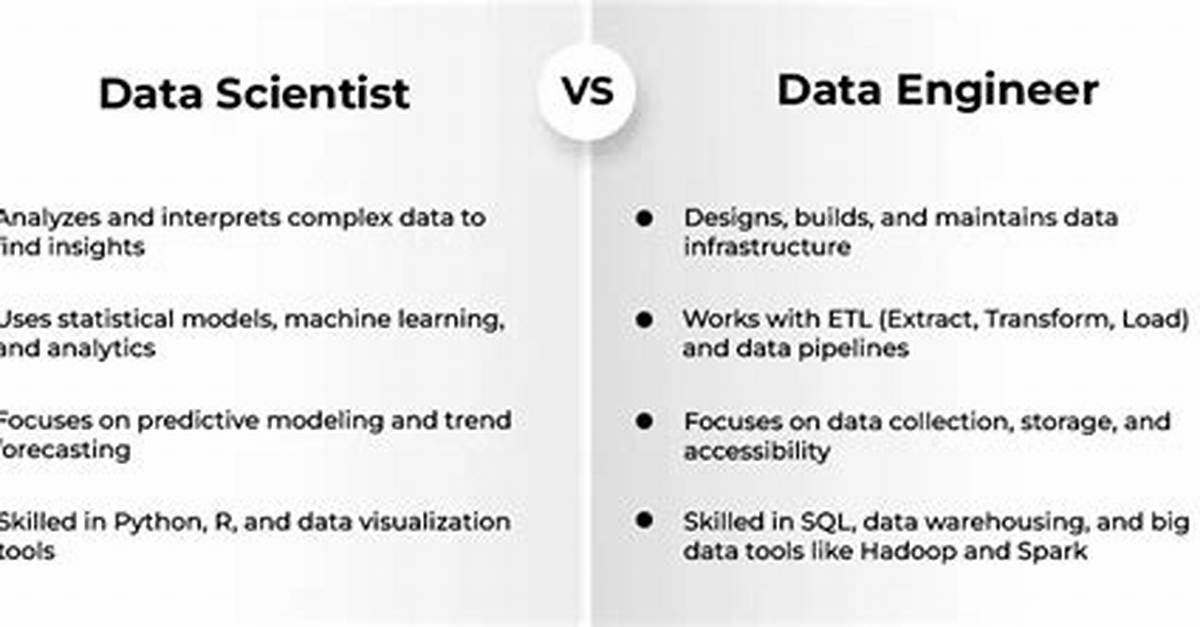
The data engineer equips the business with the ability to move data from place to place, known as data pipelines. Data engineers provide data to the data science teams.
The data scientist consumes data provided by the data engineers and interprets it to say something meaningful to decision-makers in the company.
In this article, let’s dive a little deeper into the roles of data engineer and data scientist.
What is a Data Engineer?
In general, the data engineers are responsible for building pipelines, architecting the back-end databases, creating queries, and more.
Responsibilities
The data engineer will often possess a degree in computer science or engineering. Their skills involve building and working with computers directly. They build databases, queries to interact with the databases, move data from one database to another, transform the data to be sent as the right type to its end point. They are the ones who build APIs.
Data engineers will use a number of computer languages to get the job done. At their level, the best language depends on the task and the equipment they are working with. Java, Scala, C++, Go, and Python may be used.
Skills
- Writing database queries
- Building database pipelines
- Building APIs
- Coding language: Java, Scala, C++, Go, Julia, Python
Must Read
What is a Data Scientist?
The data scientists might have to know only a little computer coding to ingest the data from the engineer’s sources, and to transform it to fit their needs.
Data scientists’ skillset is founded more on having good reasoning and communication skills. Their job tends to be highly mathematical and statistical. They need to be able to:
- Create hypotheses around the data sets
- Test the hypotheses
- Put what they learn into communicable information to decision-makers
Responsibilities
Data scientists are responsible for consuming data from a source, and finding valuable information from it. Then, they are tasked with presenting the information often through a visualization.
Data scientists will have to:
- Identify relevant data sources
- Filter through structured and unstructured data
- Analyze the data for trends
- Prepare a reports and visualizations
Skills
- Strong mathematical and statistical skills
- Source, filter, clean, and verify data
- Excellent ability to reason and communicate
- Build visualizations and data dashboards
Increasingly, data scientists are adding machine learning to their skillsets, too.
(Find out why Python is the predominant coding language for big data.)
Maya is a hardware enthusiast who tests and reviews smart home devices, smartphones, wearables, and audio gear. She focuses on practical consumer value and build quality.
