
Deep Learning vs Machine Learning: What’s the Difference?

Artificial Intelligence Is Machine Learning Is Deep Learning, Right? Wrong. Instead, Think of Them as Layers of an Onion: Artificial Intelligence Is the Large...
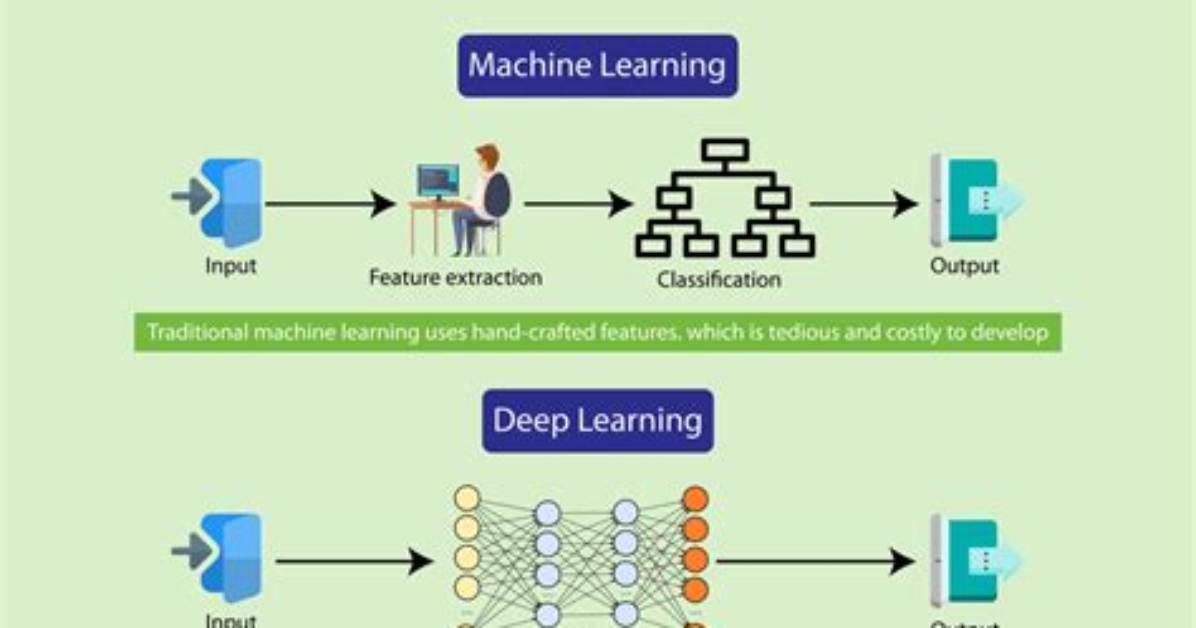
Artificial intelligence is machine learning is deep learning, right? Wrong. Instead, think of them as layers of an onion: artificial intelligence is the large, shifting outer peel that can encompass a variety of technologies, applications, and philosophies. Of AI technologies, machine learning is one tool – a statistical tool – that can speed up analysis of large datasets. Deep learning, then, is a small, more intense part of M, that is defined by how that statistical tool’s setup, functionality, and output.
It is incorrect to use the terms ‘deep learning’ and ‘machine learning’ interchangeably. Both models do use statistics to explore data, extract useful meaning or patterns, and make predictions accordingly. Both models are a newer type of AI modeling that contrasts with classic rule-based algorithmic systems.
But, these data modeling paradigms aren’t the same – deep learning can output information that is quicker to use and can seem closer to an AI we imagine. Let’s take a look.
An overview of machine learning
Machine learning is any approach that employs algorithms to sift through data and find patterns. Though a statistical process, it resembles a machine performing a specific mechanical function. The algorithm performs a function, set by the engineer or programmer, and then parses through the data to provide your answer.
As the algorithmic model works its way through a given dataset, the model tends to get better at that function. Perhaps the algorithm has to sift through thousands of pictures of cars zooming through traffic lights to determine which were red lights, warranting a ticket, and which were not. The first few tries, the algorithms won’t get everything right, but over time, it will increase in accuracy, improving well beyond human error.
Some examples of machine learning:
- Spotify or Apple Music serving up new musicians you may like, based on your listening history alongside an aggregate of users with similar interests also like
- A program seeking out malware
- An app that can find favorable financial trades or opportunities
Machine learning is automated, but only to a point. In machine learning, the programmer must still provide guidance, so that if the algorithm spits out a bad or wrong prediction, the programmer must step in and adjust.
Going further with deep learning
Any mention of deep learning will soon be followed by the term “neural networks”, the concept that deep learning is modeled on the human brain’s processing capabilities. This isn’t wholly incorrect, but this explanation tends to overstate the capabilities of deep learning.
Here are the facts: deep learning is a subset of machine learning. Deep learning functions similarly to ML using algorithms and vast amounts of data, but its capabilities go far beyond ML, so its results seem more “intelligent” or sophisticated. Instead of one or two algorithms working at once, as in ML, deep learning relies on a more sophisticated model that layers algorithms. This is known as an artificial neural network, or ANN.
It is this artificial neural network that is inspired, theoretically, by our own brains. Neural networks continually analyze data and update predictions, just as our brains are constantly taking in information and drawing conclusions. Deep learning examples include identifying faces from pictures or videos and recognizing spoken word.
One major difference is that deep learning, unlike ML, will correct itself in the case of a bad prediction, rendering the engineer less necessary. For example, if a lightbulb had deep learning capabilities, it could respond not just to “it’s dark” but to similar phrases like “I can’t see” or “Where’s the light switch?”
Robert Thorne covers electric vehicle innovations, autonomous driving systems, global mobility trends, and automotive engineering developments.
