
Derivative of the Absolute Value Function

When It Comes to Calculus, One of the Key Concepts That Students Need to Understand Is the Derivative of the Absolute Value Function. Learn More About the...
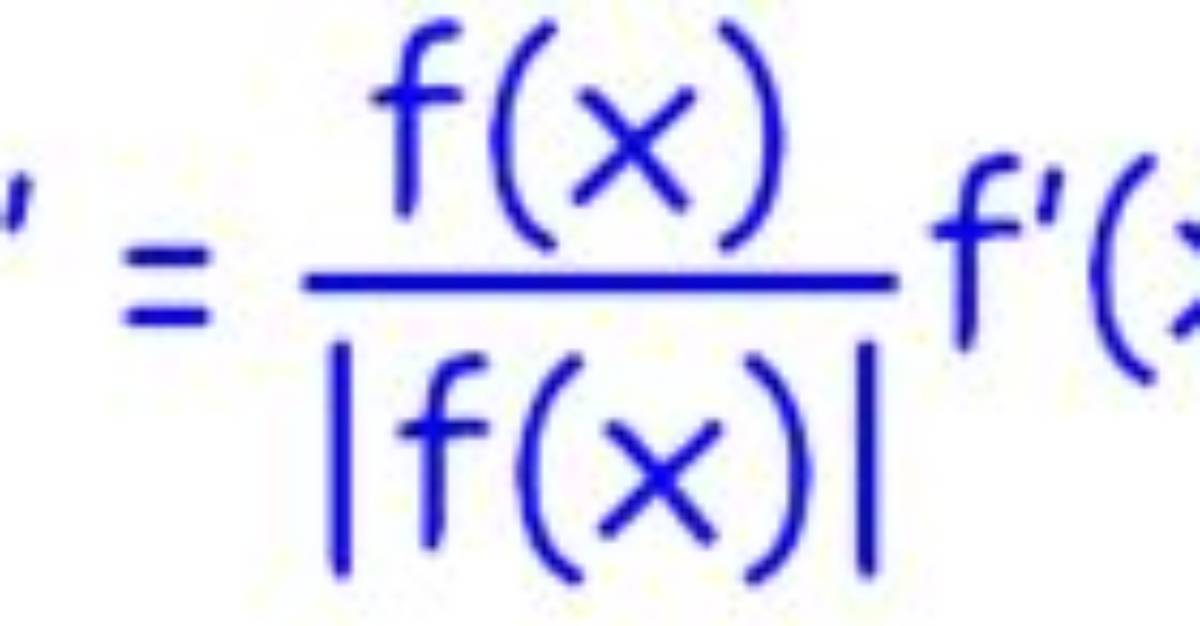
When it comes to calculus, one of the key concepts that students need to understand is the derivative of the absolute value function. Learn more about the derivative of the absolute value function by reading below.
When it comes to calculus, one of the key concepts that students need to understand is the derivative of the absolute value function. Learn more about the derivative of the absolute value function by reading below.
Image source: Fresherslive
Derivative of the absolute value function
The absolute value function is a function that returns the absolute value of a given number, which is its distance from zero on the number line. The derivative of the absolute value function can be a bit tricky because the absolute value function is not differentiable at zero. This is because the function changes direction at zero, and it is impossible to define a unique slope at this point. However, we can still define the derivative of the absolute value function everywhere except for at zero.
To find the derivative of the absolute value function, we need to use a piecewise function that takes into account the different behavior of the absolute value function for positive and negative numbers. We can define the absolute value function as:
f(x) = |x| = { x, x >= 0; -x, x < 0 }
For x > 0, the derivative of f(x) is simply:
f'(x) = d/dx (x) = 1
This is because the absolute value function is just the identity function for positive values of x, so its derivative is always equal to one.
For x < 0, the derivative of f(x) is:
f'(x) = d/dx (-x) = -1
This is because the absolute value function is just the negative of x for negative values of x, so its derivative is always equal to negative one.
At x = 0, the derivative of the absolute value function is undefined. This is because the absolute value function changes direction at zero, and it is impossible to define a unique slope at this point.
To summarize, the derivative of the absolute value function is a piecewise function that takes into account the different behavior of the absolute value function for positive and negative values of x. For positive values of x, the derivative is always equal to one, and for negative values of x, the derivative is always equal to negative one. At x = 0, the derivative is undefined.
It is important to note that although the derivative of the absolute value function is not defined at zero, the function itself is still continuous everywhere. This means that the function is still differentiable on its domain, except for at the point x = 0. Additionally, we can still use the derivative of the absolute value function to solve optimization problems and to find the maximum and minimum values of functions that involve the absolute value function.
Must Read
What is the derivative of an absolute value function?
The derivative of an absolute value function, denoted as |x|, is a mathematical concept that describes the rate at which the value of the function changes with respect to its input variable x. The absolute value function is defined as the distance between a given number x and the origin (0) on the number line, and it is represented by the symbol |x|. The derivative of the absolute value function has some interesting properties, and it can be used to solve problems in many fields of mathematics and science.
The derivative of an absolute value function is defined using a piecewise function. For x > 0, the derivative of the absolute value function is just 1, because the absolute value function is equal to x in this range. Similarly, for x < 0, the derivative of the absolute value function is -1, because the absolute value function is equal to -x in this range.
However, at x = 0, the derivative of the absolute value function does not exist. This is because the absolute value function is not differentiable at x = 0, meaning that it does not have a unique slope at that point. This is because the absolute value function changes direction at zero, and it is impossible to define a unique slope at this point.
To understand why the derivative of the absolute value function is a piecewise function, consider the following example. Let f(x) = |x|. The derivative of f(x) is defined as:
f'(x) = lim h->0 [(f(x+h) - f(x))/h]
If x > 0, then f(x+h) = x + h, so we can write:
f'(x) = lim h->0 [(x+h - x)/h] = lim h->0 [h/h] = 1
This shows that the derivative of the absolute value function is equal to one for x > 0. Similarly, if x < 0, then f(x+h) = -x - h, so we can write:
f'(x) = lim h->0 [(-x-h + x)/h] = lim h->0 [-h/h] = -1
This shows that the derivative of the absolute value function is equal to negative one for x < 0. However, when x = 0, the function is not differentiable because it is not continuous at that point.
In summary, the derivative of the absolute value function is a piecewise function that takes into account the different behavior of the function for positive and negative values of x. For x > 0, the derivative is always equal to one, and for x < 0, the derivative is always equal to negative one. At x = 0, the derivative is undefined because the function is not differentiable at that point.
Robert Thorne covers electric vehicle innovations, autonomous driving systems, global mobility trends, and automotive engineering developments.
