
Difference Between Crocodiles and Alligators

What Are the Differences Between Crocodiles and Alligators. the Most Common Difference Between the Alligators and Crocodiles Comes from Their Appearance...
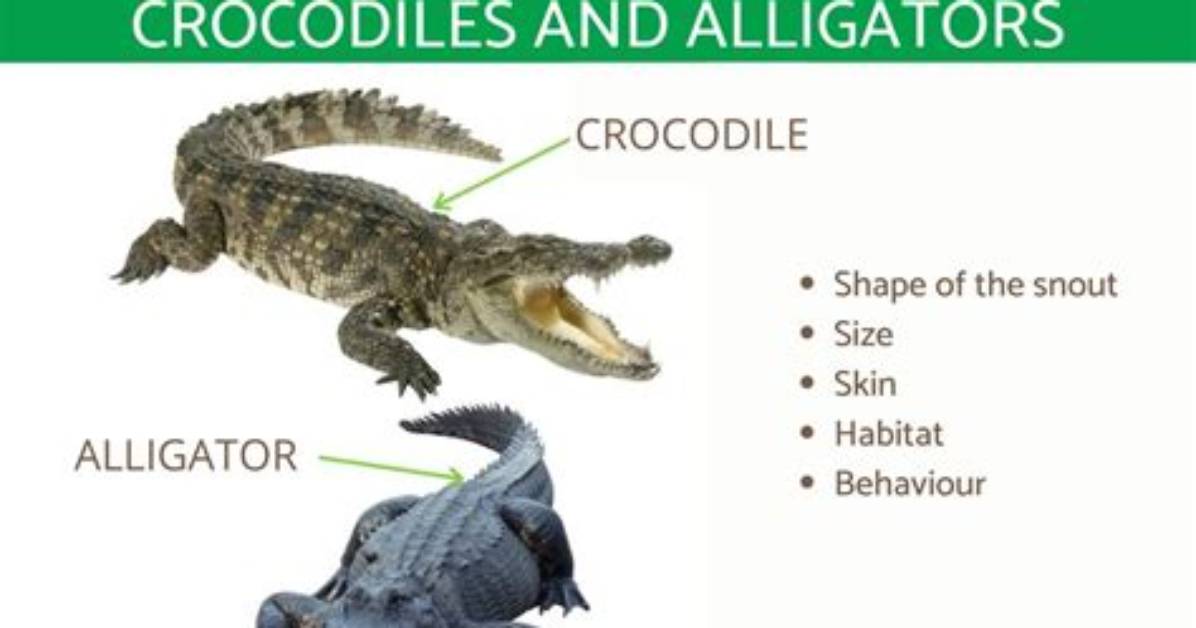
What are the differences between crocodiles and alligators. The most common difference between the alligators and crocodiles comes from their appearance. Crocodiles have longer snouts and alligators have shorter snouts. Both are from the different families. Lifespan of the crocodiles and alligators is also different because the crocodiles live longer than alligators.
| Alligators | Crocodiles | |
|---|---|---|
| Order | Crocodilia | Crocodilia |
| Family | Alligatoridae | Crocodylidae |
| Number of Species | 2 | +12 |
| Warm-blooded or cold-blooded? | Cold-blooded | Cold-blooded |
| Distinguishing Feature | Wide U-shaped snouts; dark hide color | Narrow V-shaped snouts; light hide color; “toothy smiles” |
| Lifespan | 30-50 years | 70-100 years |
| Weight and Height | 70-1000 pounds; 4,5-15 feet | 13-2000 pounds; 6-20 feet |
| Preferred Habitat | Fresh water environments | Fresh and salt water environment |
| Predators | No natural predators | No natural predators |
| Prey | Birds, fish, reptiles, small mammals and fruit | Frogs, birds, fish, crustaceans and large mammals |
| Mating Season | April-June | July-August |
| Location | U.S. (Southern); China (eastern) | All over the world |
Crocodiles and alligators share many similarities but there are some obvious differences between them. In this article we will describe the key differences between crocodiles and alligators.
Overview of Crocodile vs Alligator
Crocodiles and alligators are reptiles from the same order, crocodilian. Both have been around for about 199 million years. They are able to live on both water and land and that’s why known as the semiaquatic. They are the excellent stealth hunters with powerful jaws and keen vision.
From Spanish word el lagarto, which means “the lizard”, the word “alligator” originated. It is described as “any broad-snout crocodilian.” Their family is known as the Alligatoridae within the Crocodilian order.
From the Ancient Greek word krokodeilos, which also means “lizard”, the word “crocodile” originated. Their family is known as the Crocodylidae within the Crocodilian order.
Species of crocodiles are over a dozen and the species of alligators are only two that are found around the world. Following is the list of crocodile vs alligator species:
Crocodile Species
-
Slender-Snouted (Crocodylus cataphractus)
-
Siamese (Crocodylus siamensis)
-
Saltwater (Crocodylus porosus)
-
Philippine (Crocodylus mindorensis)
-
Orinco (Crocodylus intermedius)
-
Nile (Crocodylus niloticus)
-
New Guinea (Crocodylus novaeguineae)
-
Mugger (Crocodylus palustris)
-
Morelet’s (Crocodylus moreletii)
-
Gharial (Gavialis gangeticus)
-
Fresh water (Crocodylus johnsoni)
-
Dwarf (Osteolaemus tetraspis)
-
Cuban (Crocodylus rhombifer)
-
American (Crocodylus acutus)
Alligator Species
-
Chinese (Alligator sinensis)
-
American (Alligator mississippiensis)
Main Differences between Crocodile and Alligator
Many people are not aware of the difference between a crocodiles and alligators and utilized both terms interchangeably to define the any large water-dwelling lizard with huge teeth. People do not realize that despite some similarities both don’t behave or look same. Both have different biological families. Following are the main differences between crocodile and alligator.
1. Appearance Difference
The most common difference between the alligators and crocodiles comes from their appearance. Physiology of all the crocodilians is roughly the same. They have a lizard-like body and a scaly, tough skin, with an elongated tails and snout. They have four legs and their legs are small in comparison to their overall body. They have webbed toes, nostrils and years and they have eyes that sit on the top of their head.
They are cold-blooded and to help regulate their body temperature utilize their environment. To get warm they hang out in the sun and to cool down they sleep into the shade or water. They are also described by their jaws which have weak muscles for opening and powerful muscles for closing.
One obvious difference between the crocodile and alligator species is their snouts. Alligators have wide, U-shaped snouts. The snouts help them crack through tough shells of prey. In alligators usually one teeth from top part of their mouths are visible when they close their mouths. Alligators on average tend to be smaller than the crocodiles.
The snouts in crocodile are narrow, long and pointed V-shaped and these snouts are great for cracking through diversity of prey that crocodiles around the world eat. Crocodiles on average are tend to be larger than the alligators.
2. Color Difference
Crocodile hides have light tan or olive color and alligator often appearing dark gray and black in color and that’s why they are known to have darker hides than crocodiles. The quality of water in which the alligator swims determines the exact shade of an alligator skin. Tannic acid and algae will also change their color the tannic acid from the overhanging trees will make them darker and algae will make them greener.
3. Habitat: Freshwater or Saltwater
Habitat of the crocodiles is the salt water. There are special glands in the tongue of crocodiles which excrete excess salt from their bodies. This indicates that they are capable spending days or even weeks at sea.
Habitat of the alligators is the freshwater. They also have special glands in their tongue but they don’t work as well and that’s why they usually stick to freshwater habitats but sometimes they are also found in brackish water. A mixture of fresh water and salt is known as the brackish water.
This difference actually describes why crocodiles have managed to spread across the islands of the Caribbean and alligators haven’t.
4. Where Do Alligators and Crocodiles Live?
In southeastern US and eastern China the alligators are found. In Africa, South America, Australia, North America, Southeast Asia and Central America the crocodiles are found. If you are in US then there are more chances that you encounter an alligator instead crocodile. In the southernmost tip of Florida only the American crocodile species live.
Alligators are found across Louisiana and Florida as well as in parts of Mississippi, Georgia, Texas, Oklahoma, North and South Carolina and Arkansas. Because alligators prefer freshwater environments and warmer climates and they can’t process salt the way crocodiles can.
In the US alligators heavily outnumber crocodiles. There are over 3.5 million alligators, but fewer than 2100 crocodiles. In the world South Florida is the only place where you will find alligators and crocodiles living side by side.
Crocodiles can live in both saltwater and freshwater habitats. They are found throughout the world because of their adaptability. Europe and Antarctica are the only continents that don’t have crocodiles.
5. They have different Teeth
Snouts of crocodiles and alligators are easy to tell apart when their mouths are closed, because the bottom teeth of the alligator are not visible but the crocodile’s lower fourth tooth can always be seen.
Many teeth of crocodiles are visible because they are sticking out over their lips giving them a toothy smile. Alligators can hide all its teeth when their mouth is closed.
6. Which are bigger: Crocodiles or Alligators
Crocodiles are bigger than alligators because the maximum length of crocodile is 19 feet and the maximum length of alligators is 14 feet. Alligators are weighing anywhere from 80 to 1000pounds. Chinese alligators are generally shorter than their American counterparts; they have been measured at 4 to 5 feet, whereas the American alligators can range from 11 to 14 feet in length.
Size of the crocodiles varies due to the number of species there are. The smallest species weigh around 12 to 16 pounds and can measure about 5 feet in length, whereas the largest species weigh close 2000 pounds and can measure more than 20 feet in length.
7. Which runs and swims faster: Crocodile and an alligator
On Land: For short distances both can move quickly on land. Both have the ability of “sprint” and “gallop” but they do it when threatened, and not for long. An alligator runs faster than the crocodile because an alligator might reach a maximum speed of about 10 mph(17kph) and a crocodile might reach almost 9 mph(14kph).
In Water: In water they are both much more fast and agile. In water they can utilize their muscular long tails to propel their bodies forward. An alligators swims faster than the crocodile because an alligator might reach the speed of maximum 20 mph (32 kph) and crocodiles during the swimming might reach speeds of about 9 mph (15 kph).
8. Which is more Aggressive: An alligator or a crocodile?
Crocodiles: They are far more likely to attack humans, even unprovoked and they are much more bad-tempered. The most dangerous crocodiles that are considered in the world are the American crocodiles and they are one of the more timid types that you will find. They rarely attack humans. You are more likely to be attacked by an alligator than a crocodile in the US, although the attacks by an alligator or a crocodile are very rare.
Alligators: They are dangerous but compared to the crocodile are relatively timid. If approached by humans an alligator will usually try to escape generally heading for the nearest water. When the alligators are unexpectedly provoked, disturbed or defending their young, this is the only time that wild alligators will attack humans.
Alligators are naturally afraid of humans but with regular contact they can lose some of that fear. Except in control conditions, feeding them is almost always not a good idea as they will lose some of their fear and find humans as a source of food. For prey they can also mistake pet dogs and small children.
9. Family
Crocodiles and alligators are from the different families but they are from the same scientific order. Both are the members of Crocodylia but the family of crocodiles is the Crocodylidae and the family of the alligators is the Alligatordae.
10. Skill
Both the crocodiles and alligators are the excellent hunters because they have an extremely heightened sense. Both crocodiles and alligators are a nightmare for their prey with above-water, sharp vision, sensitive hearing, night vision and vertical pupils. During the everglades airboat tour you can expect to see both the crocodile and alligator peeping them eyes up due to their above-water vision.
To detect pressure changes in the water and to capture and locate the prey both the crocodiles and alligators have small sensory pits along their jaws. Both animals prefer to swallow large chunks or swallow the animal whole and are not the fan of chewing their food.
Salt glands of crocodiles are higher functioning and due to these glands they excrete higher amounts of salt from the water than alligators can. Alligators prefer freshwater and less tolerant to saltwater environment because alligator’s glands do no function as strongly. Crocodiles are successful in migrating across multiple marine bodies with this capability.
11. Lifespan
Lifespan of the crocodiles is longer than the alligators. Between 70-100 years is the average lifespan of a crocodile. Average lifespan of an alligator is generally between 30-50 years.
Sophia analyzes international trade, startup ecosystems, retail transformation, and supply chain logistics for modern digital publications.
