
Difference Between Natural and Whole Numbers

Natural Numbers and Whole Numbers Are Both Types of Integers, but They Differ in Terms of Their Definitions and the Sets of Numbers They Include. Here's a...
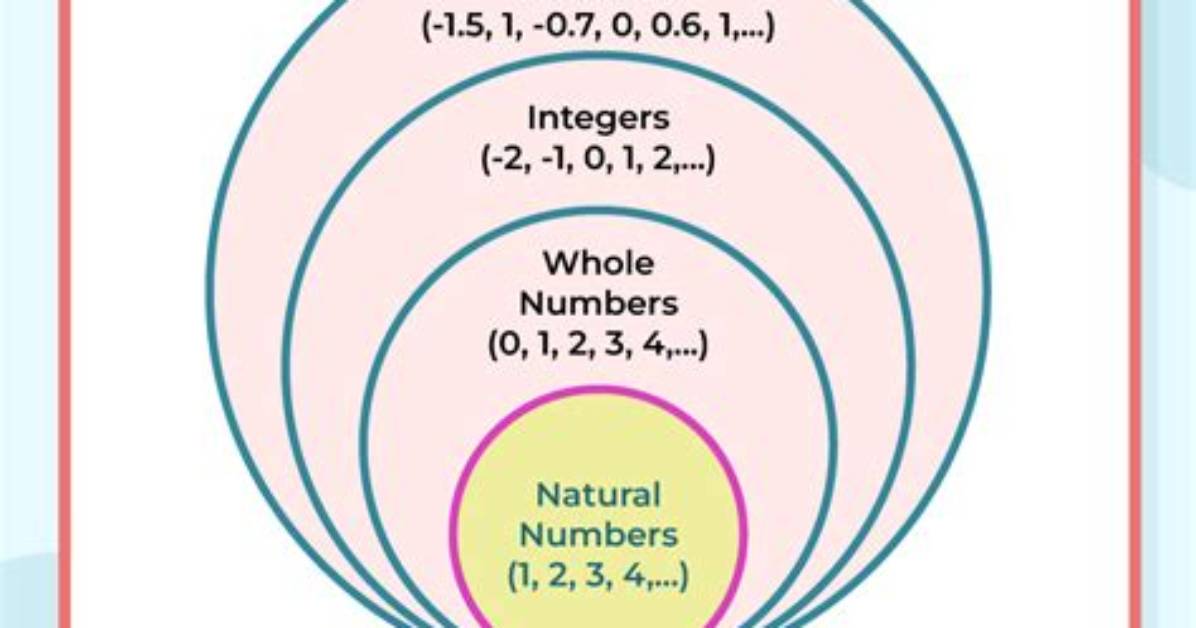
Natural numbers and whole numbers are both types of integers, but they differ in terms of their definitions and the sets of numbers they include. Here's a breakdown of the differences between natural and whole numbers:
Natural Numbers:
Natural numbers are a set of positive integers that start from 1 and go infinitely upwards.
They are used for counting and ordering, and they do not include negative numbers, fractions, or decimals.
In mathematical notation, natural numbers are often denoted by the symbol N or ℕ.
Example: N = {1, 2, 3, 4, 5, ...}
Whole Numbers:
Whole numbers are a set of integers that include all the natural numbers along with zero.
Unlike natural numbers, whole numbers can include zero (0), but they still do not include negative numbers, fractions, or decimals.
In mathematical notation, whole numbers are often denoted by the symbol W or ℤ⁺.
Example: W = {0, 1, 2, 3, 4, ...}
In summary, the key difference between natural numbers and whole numbers is that natural numbers start from 1 and go infinitely upwards, while whole numbers include all natural numbers along with zero. Neither set includes negative numbers, fractions, or decimals. Both types of numbers are fundamental in mathematics and are used in various mathematical operations and concepts.
What are Natural Numbers?
Natural numbers are a set of positive whole numbers that are used for counting and ordering objects. They are often denoted by the symbol "N" and typically start with the number 1, extending indefinitely to the right on the number line. In other words, natural numbers are the set of numbers {1, 2, 3, 4, 5, ...}.
Key characteristics of natural numbers include:
- They are always positive: Natural numbers do not include zero or any negative numbers. They are used to count items, so they represent quantities of objects.
- They are infinite: There is no largest natural number. You can always find a larger natural number by simply adding 1 to the largest known natural number.
- They are used for counting: Natural numbers are fundamental in mathematics and are used for basic counting, ordering, and arithmetic operations.
Natural numbers serve as the building blocks for other sets of numbers, such as whole numbers (which include zero), integers (which include positive and negative numbers), rational numbers (fractions), and real numbers (which include all possible numbers on the number line). They play a fundamental role in various mathematical concepts and operations.
Must Read
What are Whole Numbers?
Whole numbers are a set of numbers that includes all the natural numbers (positive counting numbers) along with zero. In other words, whole numbers are a subset of integers. Whole numbers start from zero and continue indefinitely in the positive direction. They do not include fractions, decimals, or negative numbers.
The set of whole numbers can be represented as follows:
Whole Numbers = {0, 1, 2, 3, 4, 5, 6, ...}
Key characteristics of whole numbers:
- They are non-negative: Whole numbers are all greater than or equal to zero.
- They are countable: You can use whole numbers to count objects or items, and they are used for basic arithmetic operations like addition, subtraction, multiplication, and division.
- They are discrete: Whole numbers are distinct values, and there are no numbers between them.
Whole numbers are commonly used in mathematics and everyday life for various purposes, including counting, ordering, and representing quantities that cannot be expressed as fractions or decimals.
David Miller brings 15 years of experience in global economics, personal finance strategy, and market dynamics. He specializes in turning complex economic trends into actionable insights for everyday readers.
