
Ferrari F40 (Ultimate Guide)

Ferrari F40 Contents Ferrari Brief History Celebrating 40 Year's Engine & Chassis Iconic Supercar Price and Production Critical Response Performance Numbers...
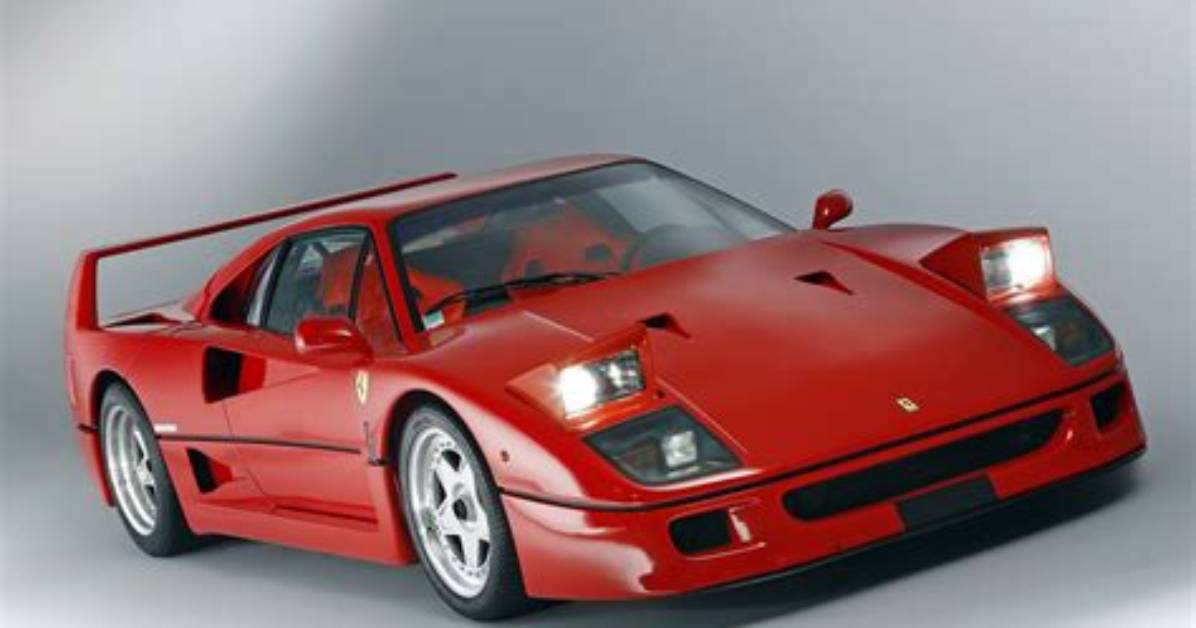
Ferrari F40
Contents
Ferrari Brief History
Celebrating 40 Years
Engine & Chassis
Iconic Supercar
Price and Production
Critical Response
Performance Numbers
Specifications
Race Models
Pictures & Videos
To celebrate 40 years of Ferrari, Enzo had his design team create a supercar that translated racing car technology to the road. Furthermore, it was built with only the most essential systems and in many regards is a supercar with functional simplicity.
It was also the last car developed and built under Enzo Ferrari’s direct supervision before he died. Following the turbocharged successes in Formula One, the 288 GTO was Ferrari’s first road-going turbocharged model in 1984. The F40 followed in its path and shared its longitudinal, mid-mounted, twin turbocharged V8 configuration. Power came from a large V8 engine that produced 478 bhp and 426 lb-ft torque.
Incorporating advanced composite materials, the F40 was very light. It used a Kevlar for the body which was integrated into a steel chassis. This body/chassis unit was fabricated by Scaglietti and finished at Ferrari’s own factory. The F40 shape was developed by Pininfarina to reduce frontal area, drag and lift. They also designed a lexan hood to reveal the twin-turbo V8 engine.
Ferrari – A Brief History of an Automotive Icon
When it comes to automobile manufacturers, there are few who rival the performance, the allure or the mystique of those found in the Italian Sports Car market.
For the past half century, companies like Lamborghini, Maserati, Lancia and, more recently Pagani and Spada Vetture Sport, have showcased some of the fastest, most seductive, and most powerful automobiles the world has ever known. Yet, as successful as each of these companies are, there is no other automotive manufacturer from Italy (or, arguably, pretty much anywhere on the planet) that has captured the imagination of automotive enthusiasts like Ferrari has.
Since its founding as an automotive manufacturer in 1947, Ferrari has been responsible for introducing many of the most popular, most successful, and most desired sports cars of any manufacturer ever.
Enzo Ferrari began his company as Scuderia Ferrari S.p.A. in 1939. His initial business model was to build a team that would buy, customize, and field race cars built by Alfa Romeo.
Within a few short years, Enzo recognized that he could accomplish more on the racetrack by building his own cars, and set to work on the Ferrari 125 S – the first (of many) cars to officially wear the Ferrari badge.
For the next forty years, the Ferrari corporation, led by Enzo Ferrari himself, would create some of the fastest, most luxurious sports cars the world had ever seen. While Ferrari began building production vehicles fairly early in its tenure as an automobile manufacturer, it was always Enzo’s intention to use his production vehicles to generate revenue to fund his racing aspirations – both as a driver and as a team owner.
Despite this, and amidst controversy throughout his long career, Enzo would go on to oversee the design and production of all the cars his company produced – both for the track and for commercial sales.
The F40 – A Car to Celebrate 40 Years of Ferrari
To celebrate Ferrari’s 40th anniversary, it was decided that the company would produce a mid-engine, rear wheel drive, two-door coupe sports car. It would be the fastest, most powerful car the company had ever built. This car, appropriately enough, would be called the Ferrari F40.
The Ferrari F40 was built from 1987 to 1992, with racing variants in both the LM and GTE racing classes which were produced until 1994 and 1996 respectively. It was intended as the successor to the Ferrari 288 GTO, which itself had been one of the fastest production Ferrari models ever built (up to that point in time.)
The Ferrari F40 was built out of Enzo’s desire to leave a legacy in his final supercar. His vision was to build a street legal vehicle that was developed directly from a track-ready race car. Ironically, the F40, which was the byproduct of that vision, came into being by unfortunate happenstance.
The F40 Concept
As early as 1984, Ferrari’s Maranello factory had begun development of an evolution model of the Ferrari 288 GTO which was specifically designed to compete against Porsche’s 959 in Federation Internationale de l’Automobile (FIA) Group B Class Racing. However, after a series of major accidents – some of them fatal – the FIA Group B Class was disestablished, which left Enzo Ferrari with five 288 GTO “Evoluzione” development cars, and no series in which to campaign them.
Four of the five “Evoluzione” models were eventually sold to private clients, but the fifth remained at Ferrari’s factory. Enzo recognized that if the 288 GTO could be transformed from a performance street machine into a full-on racer, it seemed plausible that the reverse could be true as well. Utilizing the last remaining Ferrari 288 GTO Evoluzione as a starting point, Ferrari set about manufacturing the F40 with a singular focus – build a street car that performed and handled like a race car.
It made a great deal of sense, therefore, that much of the F40 evolved from variations to the mechanical components developed specifically for the 288 GTO.
Elena Rostova holds a Master's degree in Public Health Journalism. She covers groundbreaking medical research, holistic wellness trends, mental health awareness, and nutritional science.
