
How to Do Lunges | Lunges and Variations for Lower Body Strength

When It Comes to Training Your Legs, People Are Often Quick to Overlook the Benefits of Unilateral (Single-Sided) Exercises in Favour of Squat and Deadlift...
When it comes to training your legs, people are often quick to overlook the benefits of unilateral (single-sided) exercises in favour of squat and deadlift variations. Unilateral work, like lunges, can help to address any muscular size or strength imbalances between each side, which can directly improve your strength in heavier compound lifts – since unilateral exercises tend to expose weaknesses in synergistic muscles (smaller muscles that help to stabilise the joint).
Once you’ve familiarised yourself with the movements listed below, try experimenting with different rep ranges and loads – you can set yourself up with a great way to develop lower body strength, or simply get a good burn going in your muscles!
How To Do Bodyweight Lunges
Variations of the lunge predominantly work the knee extensors (quads) and the hip extensors (glutes), and to a lesser degree, the hamstrings and calves are used, although the lunge should not be used as a direct exercise for these muscle groups.
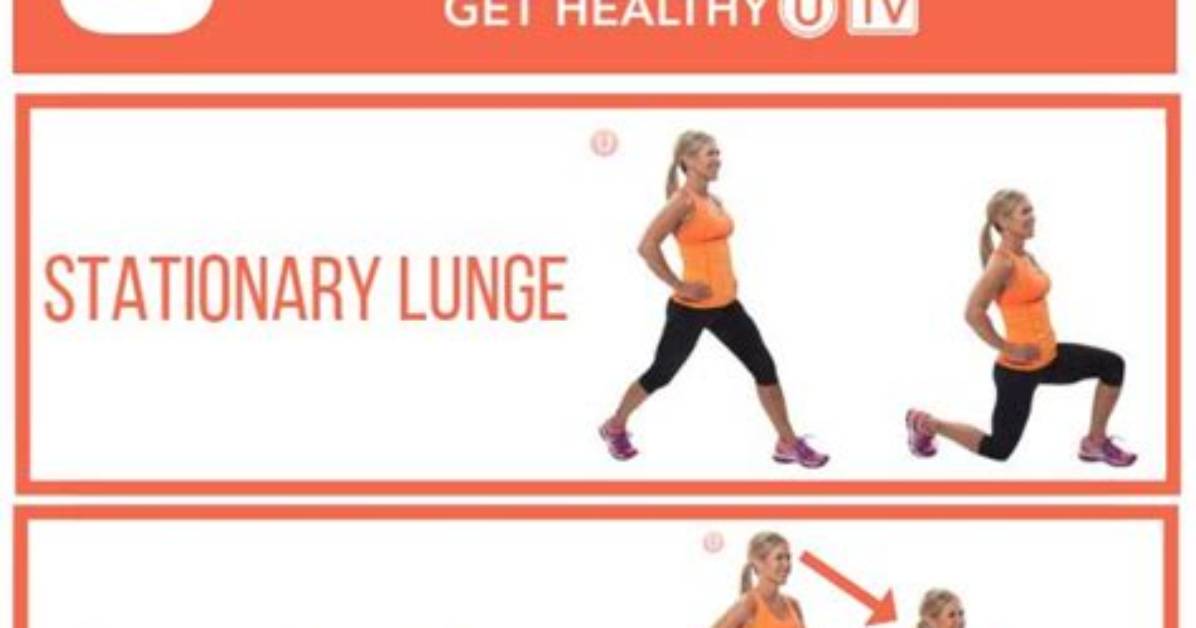
- Starting in a neutral standing position, step forward with one leg, so that your legs form a triangle with the floor, with each leg at around 45° to the floor.
- Lower your body towards the floor, allowing the knee of your front leg to track over your toes (it doesn’t matter too much whether your knees pass your toes or not – this will be down to each individuals ankle mobility).
- As you lower your body, the knee of your back leg should not touch the floor. Allow your knee to bend in the back leg. You should feel a stretch in the quads of your back leg. Both knees should be bent at around 90° in the bottom position.
- Push through the heel of your front foot, stepping back to the start position. You should feel the load in your glutes and quads.
Must Read
Common Mistakes And How To Fix Them
1. Leaning Forward
While not so much of an issue when doing a bodyweight lunge, we should aim for every rep to be perfect no matter how heavy the load or how fatigued your muscles are. You should aim to keep your torso in an upright position, especially when using loads such as dumbbells or a barbell. Keeping your torso upright ensures that you are using your core muscles (specifically your spinal erectors/lower back muscles) to stabilise the spine throughout the movement – which ultimately helps to protect against degenerative changes or injuries to your spine.
Similar to squatting, there is a common misconception that allowing your knees to go past your toes will result in injury – this is not the case for either the lunge or the squat. It is simply a case of individual flexibility and range of motion – allowing your knees to pass your toes likely means you can reach a deeper lunge, and thus use your muscles through a larger range of motion, which is an important factor for increasing muscle size and strength throughout the full range.
2. Losing Balance
If you find yourself being a bit wobbly when you perform a lunge, experiment with a wider stance (i.e. when stepping forward from the starting position, step slightly outwards too, as this will widen your base of support). If you still struggle to maintain your balance, use a focal point (stare at a specific non-moving object in your field of view) to help.
If neither of these help, then there’s no problem with using your hands to help balance, or hold on to something stable (just make sure that you don’t use your arms to help pull yourself up from the bottom of the lunge).
3. ‘Dropping’ Down
The descent of the lunge should be controlled, thus minimising the risk of injury and optimising your muscle strength and size gains in the process! As the muscles lengthen during the descent, this is known as an ‘eccentric’ contraction (only when you’re actively using the muscles to control the movement), which is where most of the muscle damage occurs in resistance exercises – which is what is striving for so that we can build bigger, stronger muscles in recovery.
4. Not Contracting Muscles
Failing to ‘squeeze’ your muscles at the end of the movement will mean that you don’t develop an optimal neuromuscular connection (mind to muscle) to your muscles – which has been identified as a key factor in developing strength, and thus size. This is where the concept of ‘newbie gains’ comes from, as the initial training stimulus results in neuromuscular adaptations prior to increases in muscle size occurring (which is why your numbers in the gym might initially fly up before hitting a plateau).
Overcoming this fault is as simple as concentrating throughout the movement and squeezing your muscles at the end of the movement (don’t worry if you don’t feel it immediately, it’s very much a ‘learned’ skill that takes time to develop!).
5. Knees Collapsing Inwards
Otherwise known as ‘genu valgum’ or ‘knee valgus’, this is when the knee of the leading leg buckles inwards across your body’s midline. This can be as a result of weaker hip muscles that are struggling to stabilise the joints below, or even as simple as those same muscles being fatigued towards the end of your workout. If not addressed, then this can lead to knee injuries, so it’s important to pay attention and address the problem by either reducing the load when you are fatigued and also by doing some hip abduction exercises (these exercises specifically strengthen the gluteus medius muscle, which is responsible for stabilising the knee).
If you have access to a long rubber resistance band, then feel free to challenge yourself (while developing strength to resist your knees caving inwards). Try securing the resistance band to a stable and immobile object, then wrap the other end around your front knee. The resistance band should be set up so that it is trying to pull your knee inwards (the movement that you don’t want to happen!) so that you can firmly resist this while you lunge – thus increasing the strength and stability in the lunge.
Alexander Ross has covered the video game industry for a decade, writing deep dives on game design, esports tournaments, VR developments, and gaming culture.
