
How to Find the Area of Shapes?

To Find the Area of Different Shapes, You'll Need to Use Specific Formulas Depending on the Shape You're Working With. Here's a Guide on How to Find the Area...
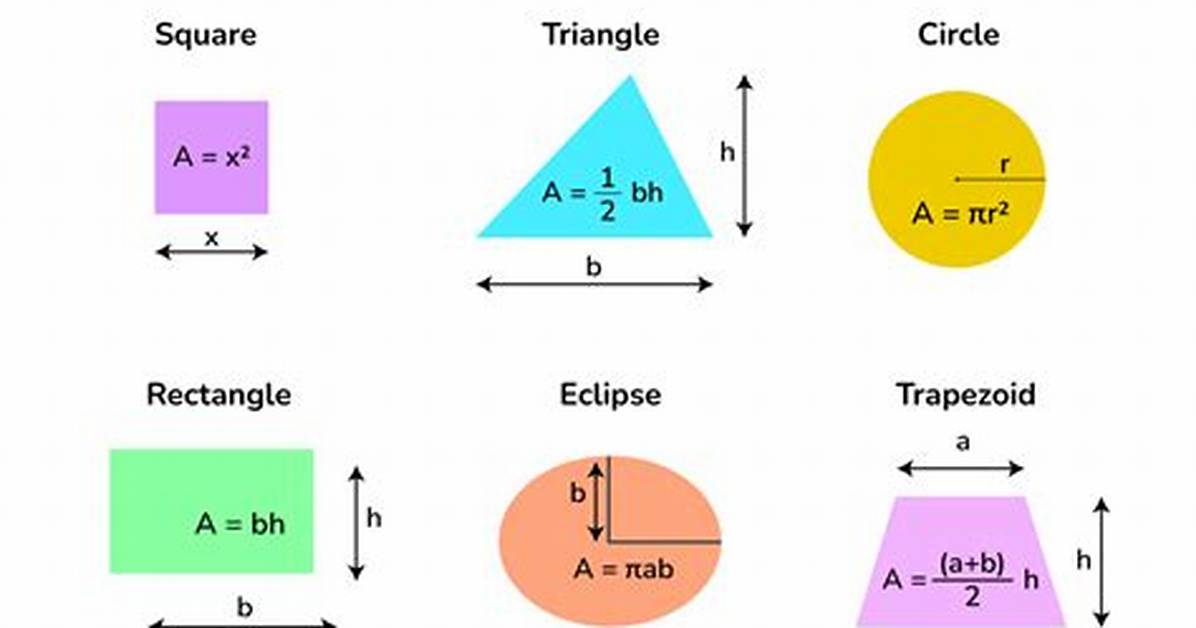
To find the area of different shapes, you'll need to use specific formulas depending on the shape you're working with. Here's a guide on how to find the area of some common shapes:
Rectangle:
- Area = Length × Width
- Square:
- Area = Side Length × Side Length (or Area = side²)
Triangle:
- Area = (Base × Height) / 2
The height should be perpendicular to the base.
Circle:
- Area = π × Radius²
π (pi) is a mathematical constant approximately equal to 3.14159. The radius is the distance from the center of the circle to its edge.
Trapezoid:
- Area = ((Top Base + Bottom Base) / 2) × Height
Parallelogram:
- Area = Base × Height
The height should be perpendicular to the base.
Ellipse:
- Area = π × Semi-major Axis × Semi-minor Axis
The semi-major axis is half the length of the longest diameter, and the semi-minor axis is half the length of the shortest diameter.
Regular Polygon:
- Area = (Perimeter × Apothem) / 2
The apothem is the distance from the center of the polygon to the midpoint of a side. Perimeter is the sum of all the side lengths.
Sector of a Circle:
- Area = (θ / 360) × π × Radius²
θ is the central angle of the sector.
Rhombus:
Area = (Diagonal1 × Diagonal2) / 2
Diagonal1 and Diagonal2 are the lengths of the diagonals that intersect at the center of the rhombus.
Remember to use the appropriate units for your measurements (e.g., square units for area) and make sure your measurements are consistent (e.g., all in the same units) before plugging them into the formulas.
For more complex shapes, you may need to break them down into simpler components and calculate their areas separately before adding or subtracting them to find the total area.
What is the Area of a Shape?
The term "area" refers to the measure of the two-dimensional space enclosed by the boundary of a geometric shape. It is typically expressed in square units, such as square meters (m²) or square feet (ft²), depending on the system of measurement being used.
The formula for calculating the area of various geometric shapes is different for each shape. Here are the area formulas for some common shapes:
- Rectangle: Area = Length × Width
- Square: Area = Side Length × Side Length (or Area = Length × Width, if all sides are equal)
- Triangle: Area = (Base × Height) / 2
- Circle: Area = π × Radius²
- Parallelogram: Area = Base × Height
- Trapezoid: Area = (Sum of the lengths of parallel sides) × Height / 2
- Ellipse: Area = π × Semi-Major Axis × Semi-Minor Axis
It's important to use the correct formula for the specific shape you're working with. Calculating the area is essential in various fields such as mathematics, architecture, engineering, and physics, as it helps determine the amount of space enclosed by a shape and aids in solving various practical problems.
How do you Find the Area of an Irregular Shape?
Finding the area of an irregular shape can be a bit more complex than finding the area of regular shapes like rectangles or circles. The general approach involves dividing the irregular shape into smaller, more manageable parts, calculating the area of each part, and then summing up the areas to find the total area of the shape. Here are a few methods you can use:
Divide and Conquer Method:
Break the irregular shape into simpler, regular shapes (triangles, rectangles, circles) that you can calculate the area for. Then, add up the areas of these smaller shapes to find the total area of the irregular shape.
Polygon Approximation Method:
If your irregular shape can be closely approximated by a polygon, you can use the formula for finding the area of a polygon. Divide the shape into triangles or trapezoids, calculate their areas, and sum them up.
Integration Method (Calculus):
For more complex irregular shapes, you can use calculus to find the area. This involves setting up an integral and integrating over the boundaries of the shape to find the area under a curve.
Software or Tools:
There are various software tools available that can help you find the area of irregular shapes. These tools often use digital image processing techniques to calculate the area based on the pixel information in an image of the shape.
Graph Paper Method:
You can draw the irregular shape on graph paper and count the number of full squares it covers. Estimate the fraction of squares covered by partial shapes and then calculate the total area.
Coordinate Geometry:
If you have the coordinates of the vertices of the irregular shape, you can use the Shoelace Formula to calculate the area.
Image Analysis Software:
If you have a digital image of the irregular shape, you might use image analysis software that can help you trace the outline of the shape and calculate its area.
The method you choose will depend on the complexity of the shape and the tools or information you have available. For simple irregular shapes, methods like the divide and conquer approach or polygon approximation are often sufficient. For more complex shapes, calculus-based methods might be necessary.
Maya is a hardware enthusiast who tests and reviews smart home devices, smartphones, wearables, and audio gear. She focuses on practical consumer value and build quality.
