
Introduction to Configuration Management

Enterprise It Assets Are Often Deployed in a Complex and Hybrid Mix of Deployment Architectures Across on-Site Datacenter and Cloud Environments. These Assets...
Enterprise IT assets are often deployed in a complex and hybrid mix of deployment architectures across on-site datacenter and cloud environments. These assets have configurations, or interface dependencies, between each other that must be identified, managed, and controlled to ensure that the IT environment behaves as required:
- Any change in configurations can dramatically impact the performance, security, and functionality of the code and the underlying IT assets.
- Infrastructure configured to run tests can be vastly different from the requirements of the production environment.
The task for IT Operations is to ensure that the configurations are managed correctly, following frameworks and guidelines such as ITIL®. In this article, we will explore the key concepts associated with configuration management, its components, and the activities involved.
What is configuration management?
ITIL defines Service Asset and Configuration Management (SACM) as: “The process responsible for ensuring that the assets required to deliver services are properly controlled, and that accurate and reliable information about those assets is available when and where it is needed. This information includes details of how the assets have been configured and the relationships between assets.”
Configuration management can also be described as activities associated with a technology platform that automates this process at scale.
Must Read
Components of configuration management
According to ITIL, service assets and configuration management are closely associated and encompass all components, products, and services that must be managed from their inception to retirement.
IT professionals involved with Configuration Management will repeatedly come across the following key concepts:
- Configuration model: A tool that consolidates interactions between dependent components and service assets that must be managed and controlled. The model connects these components, evaluating infrastructure changes and causes of incidents.
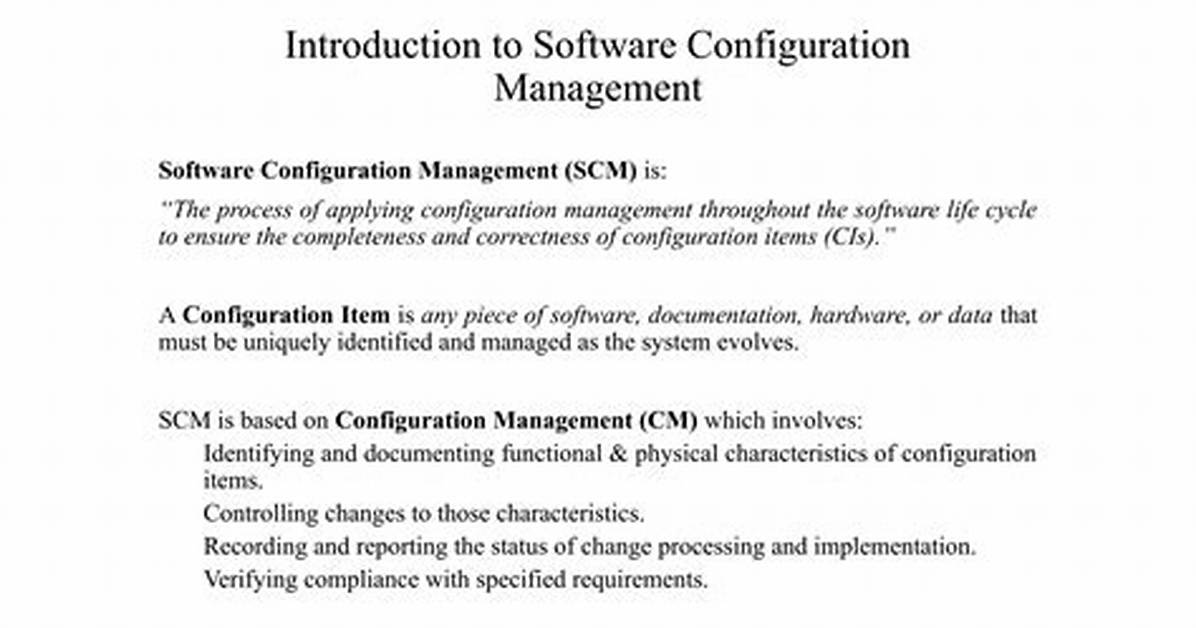
- Configuration item (CI): Any infrastructure or service component that requires management in order to enable an IT service. A CI can be a fundamental structural unit in a CMS that can be managed and modified independently of other components in the IT environment. Examples range from documents and models to hardware assets and software components.
- Configuration records: A set of records describing CI attributes and relationships.
- Configuration management database (CMDB): A database that stores configurations records, including relationships between the configuration items.
- Service asset: Resources that enable the delivery of an IT service. These can include the services provided by third-party vendors or the overall capability of an organization to address IT and security incidents. Therefore, service assets are not necessarily manageable by the organization, but the information about their state can support critical decisions related to IT service delivery.
- Definitive management library (DML): A protected library containing authorized versions of configuration items as well as master copies of controlled software and documentation. The DML also defines capacity planning activities, security arrangements, and audit procedures.
Marcus Vance is a cybersecurity auditor and technology writer dedicated to educating the public about online safety, data privacy regulations, enterprise security, and emerging cyber threats.
