
Level of Significance - in Statistics (Definition and Steps)

Level of Significance the Level of Significance, Often Denoted by the Symbol Α (Alpha), Is a Critical Component in Hypothesis Testing and Statistical...
Level of Significance
The level of significance, often denoted by the symbol α (alpha), is a critical component in hypothesis testing and statistical significance. It represents the probability of rejecting a true null hypothesis, or in other words, the probability of making a Type I error.
In hypothesis testing, you start with a null hypothesis (H0) and an alternative hypothesis (H1). The level of significance is the threshold that you set to determine whether the evidence is strong enough to reject the null hypothesis. Commonly used levels of significance are 0.05, 0.01, and 0.10.
Here's how it works:
-
Select a Significance Level (α): Common choices are 0.05, 0.01, and 0.10. A lower significance level indicates a more stringent criterion for rejecting the null hypothesis.
-
Collect and Analyze Data: Gather data and perform the statistical analysis.
-
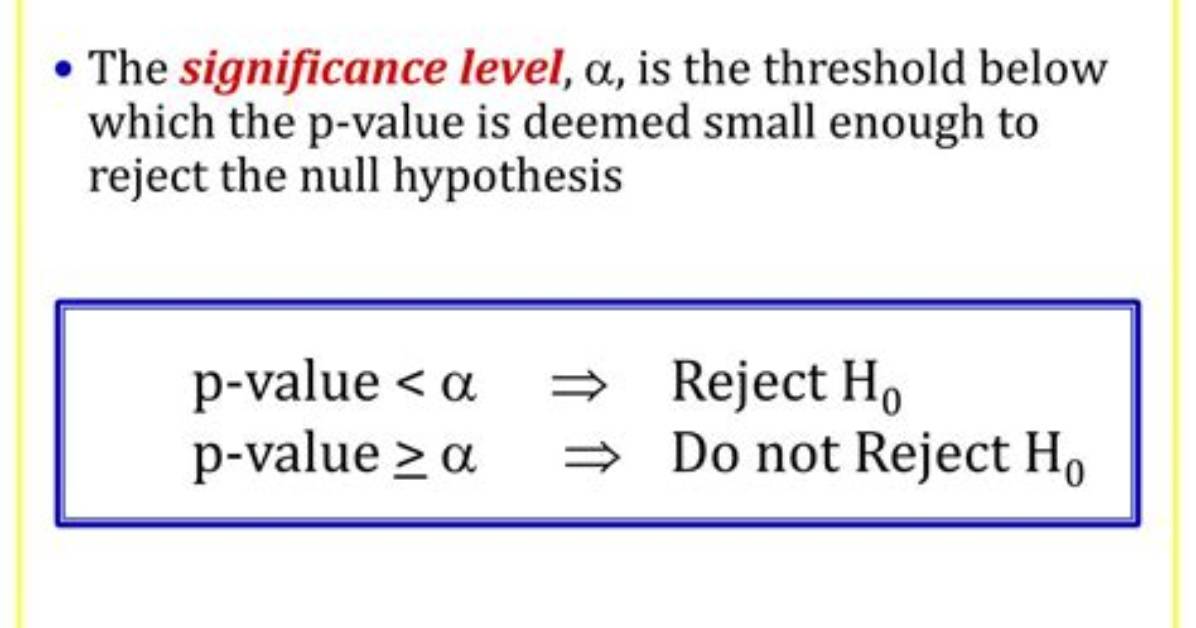
Compare p-value to α: After analysis, you obtain a p-value. The p-value is the probability of observing a test statistic as extreme as, or more extreme than, the one observed, assuming the null hypothesis is true. If the p-value is less than or equal to the chosen significance level (α), you reject the null hypothesis.
- If p-value ≤ α: Reject H0
- If p-value > α: Fail to reject H0
-
Make a Decision: If you reject the null hypothesis, you accept the alternative hypothesis. If you fail to reject the null hypothesis, you do not accept the alternative hypothesis.
Choosing the level of significance involves a trade-off. A lower significance level makes it harder to reject the null hypothesis, reducing the risk of Type I errors (false positives) but increasing the risk of Type II errors (false negatives). Conversely, a higher significance level makes it easier to reject the null hypothesis but increases the risk of Type I errors.
Researchers often choose a significance level based on the nature of the study, the consequences of Type I and Type II errors, and common practices in the field. It's important to interpret the results in the context of the chosen significance level and be aware of the potential errors associated with the decision.
Must Read
- You Are Facing North. Turn 90 Degrees Left. Turn 180 Degrees Right. Turn Around to Reverse Your Direction. Turn 45 Degrees Left. Turn Around to Reverse Your Direction. in Which Direction Are You Now Facing?
- A Chicken Farmer Also Has Some Cows for a Total of 115 Animals, and the Animals Have 304 Legs in All. How Many Chickens Does the Farmer Have?
Level of Significance Examples
The level of significance, often denoted by the symbol α (alpha), is a critical value used in hypothesis testing to determine whether to reject the null hypothesis. It represents the probability of making a Type I error, which occurs when you incorrectly reject a true null hypothesis. Commonly used levels of significance include 0.05, 0.01, and 0.10.
Here are some examples to illustrate the concept:
-
Medical Research:
- Scenario: A new drug is being tested for its effectiveness in treating a particular condition. The null hypothesis (H0) might be that the drug has no effect, and the alternative hypothesis (H1) is that the drug is effective.
- Level of Significance: α = 0.05
- Decision Rule: If the p-value is less than or equal to 0.05, you would reject the null hypothesis in favor of the alternative.
-
Quality Control:
- Scenario: A manufacturing process is being monitored for defects. The null hypothesis could be that the defect rate is within an acceptable range, and the alternative hypothesis is that the defect rate is too high.
- Level of Significance: α = 0.01
- Decision Rule: If the p-value is less than or equal to 0.01, you would reject the null hypothesis.
-
Educational Research:
- Scenario: A researcher is investigating the effectiveness of a new teaching method. The null hypothesis might be that there is no difference in student performance between the new and traditional methods.
- Level of Significance: α = 0.10
- Decision Rule: If the p-value is less than or equal to 0.10, you would reject the null hypothesis.
-
Market Research:
- Scenario: A company is testing a new advertising strategy to see if it leads to a significant increase in sales. The null hypothesis could be that there is no increase in sales.
- Level of Significance: α = 0.05
- Decision Rule: If the p-value is less than or equal to 0.05, you would reject the null hypothesis.
-
Criminal Justice:
- Scenario: A legal case is being investigated, and the null hypothesis could be that the defendant is innocent. The alternative hypothesis is that the defendant is guilty.
- Level of Significance: α = 0.05
- Decision Rule: If the p-value is less than or equal to 0.05, you might reject the null hypothesis and conclude guilt.
Remember, the choice of the level of significance depends on the context of the study and the consequences of making a Type I error in that particular field. Lower levels of significance (e.g., 0.01) are more conservative but may increase the risk of Type II errors.
Maya is a hardware enthusiast who tests and reviews smart home devices, smartphones, wearables, and audio gear. She focuses on practical consumer value and build quality.
