
Methods for Disbudding Goat Kids

Most Goat Breeds Used in Production Systems Develop Horns. Horns Have Advantages, Such as Aiding in Heat Dissipation and Providing a Defense Against Predators...
Most goat breeds used in production systems develop horns. Horns have advantages, such as aiding in heat dissipation and providing a defense against predators. However, they also may have negative effects, such as compromising the safety of handlers and other goats in the herd, as well as getting caught in facilities. Although they are often used interchangeably, the terms “disbudding” and “dehorning” have different meanings. Disbudding refers to the destruction of the horn-producing cells of the horn bud, which typically occurs before 2 weeks (14 days) of age. After 2 weeks, horns on a goat kid will fuse to the frontal sinus, making it more difficult to remove and more intrusive than disbudding. This process is known as dehorning: the procedure of removing horns after they have fused to the sinus of the animal, which typically occurs after 2 weeks of age. When the horns are visibly protruding from the head (Figure 1), it is too late to remove the horns by disbudding. The practice of dehorning is more invasive and should be performed by a veterinarian, whereas disbudding is a management practice that can be done by all goat producers.
Removing a kid’s horns when it is at a younger age can be less traumatic to the animal because the horn is not yet attached to the skull. Dehorning at later ages may have negative effects on the animal’s performance due to the associated stress and trauma. Methods for disbudding and the process of restraining younger animals are also typically easier compared with restraining and dehorning older animals. Because of the animal welfare and management implications, all goat kids should be disbudded between 4 and 14 days of age. Additionally, using proper techniques when performing disbudding procedures decreases the opportunity for scurs (malformed horn tissue that remains after improper disbudding), injury, infection, or even permanent trauma to the brain of the goat.
Industry Statistics
According to the 2019 USDA Goat NAHMS report, 87.9 percent of all operations in the United States had kids that had or were expected to grow horns. This statistic does not vary much based on herd size. When evaluating the occurrence of horned kids based on the production scheme, dairy operations (92.4 percent of operations) were most likely to have horns on their farm (91.4 percent of kids having or expected to have horns) than meat and “other” operations. The average age at which producers in all operations remove horns from their goat kids for was 16.3 days. However, meat goats were typically the oldest at horn removal (20.2 days) followed by dairy (14.6 days) and “other” (13.9 days). The age at which all operations typically remove horns is close to or exceeds the minimum age recommended for disbudding (between 4 and 14 days). Therefore, there is room for all operations to remove horns before they fuse to the kids’ skulls, and disbudding is the most effective, safest, and easiest method.
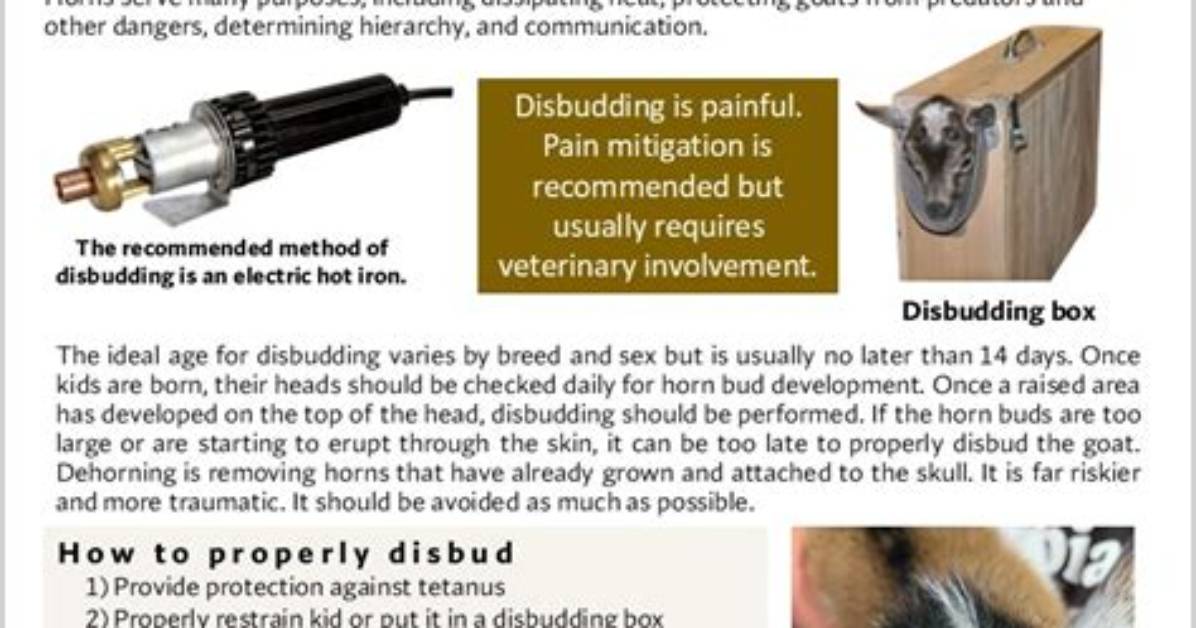
For operations that removed horns from goat kids, the most popular method was using an electric dehorner, otherwise known as a hot iron (95.7 percent of operations). This method was then followed by caustic paste and “other” methods (1.8 percent and 2.4 percent, respectively). Other methods include rubber bands, shears, or veterinarian’s preference. There was very little difference in disbudding/dehorning methods among meat, dairy, and “other” operations. Farm owners were most likely to administer the procedures (75 percent of operations), followed by veterinarians (16.5 percent), herd managers (1.4 percent), and “other” (7.1 percent).
Must Read
Pain Mitigation
The only painless way to have hornless goats is to select animals that genetically do not have horns from birth. Removing horns from an animal is a painful procedure. Pain mitigation in goat kids during disbudding procedures is important to the welfare of the animal and the safety of both the handler and the animal. It should be a priority to ensure the removal of horns causes the least amount of stress possible to the animal. Although disbudding may be less painful than dehorning, there is still associated pain, and mitigation is recommended for both procedures. In a study evaluating wound healing and pain response in disbudded goat kids, researchers observed a healing time of 7 weeks, and pain was present in the disbudding site during that time. Therefore, a short-term and long-term pain management program may be beneficial. Pain mitigation can include nonsteroidal anti-inflammatory drugs (NSAIDs), local anesthetics, topical anesthetics, or a combination of pain-reducing and pain-relieving drugs. Lidocaine, although a useful local anesthetic in large ruminants, should be used with caution in goats. Goats are more sensitive to lidocaine than other livestock species. Lidocaine can be safely used for goats when the dose is diluted, buffered, and does not exceed more than 6 mg/kg of body weight. A local anesthetic useful for goats is Bupivacaine (0.25 percent to 0.5 percent solutions), with a sufficient dose of 1 to 2 mg/kg of body weight.
Of the U.S. operations that perform horn removal, only 30 percent provide analgesics or anesthetics during the disbudding procedure. Anesthetics are a pain mitigation method that causes loss of physical sensation, which may or may not be accompanied by loss of consciousness. Analgesics provide pain relief without loss of physical sensation or consciousness. When you consider that a hot iron is used in 95.7 percent of goat operations to remove horns, there is an opportunity to increase the use pain mitigation to decrease the stress on the animal during and after the procedure.
Research on the use and effectiveness of pain management is still ongoing in small ruminants. However, current research has shown the effectiveness of providing a long-lasting NSAID in conjunction with a local anesthetic to provide some relief to goat kids around disbudding. The best pain mitigation strategies are those that are effective, economical, and safe for both humans and animals. To make the best decision for your operation, consult your veterinarian to formulate a pain management protocol.
James Sterling reports on renewable energy developments, climate policy, ecological conservation, and green tech innovations around the globe.
