
Minecraft Blocks Wiki Guide 2024 (January)

Blocks Are What Minecraft Is All About. They’re the Building Pieces That Make up the World You Play In, and Allow You to Let Your Imagination Go Wild. Almost...
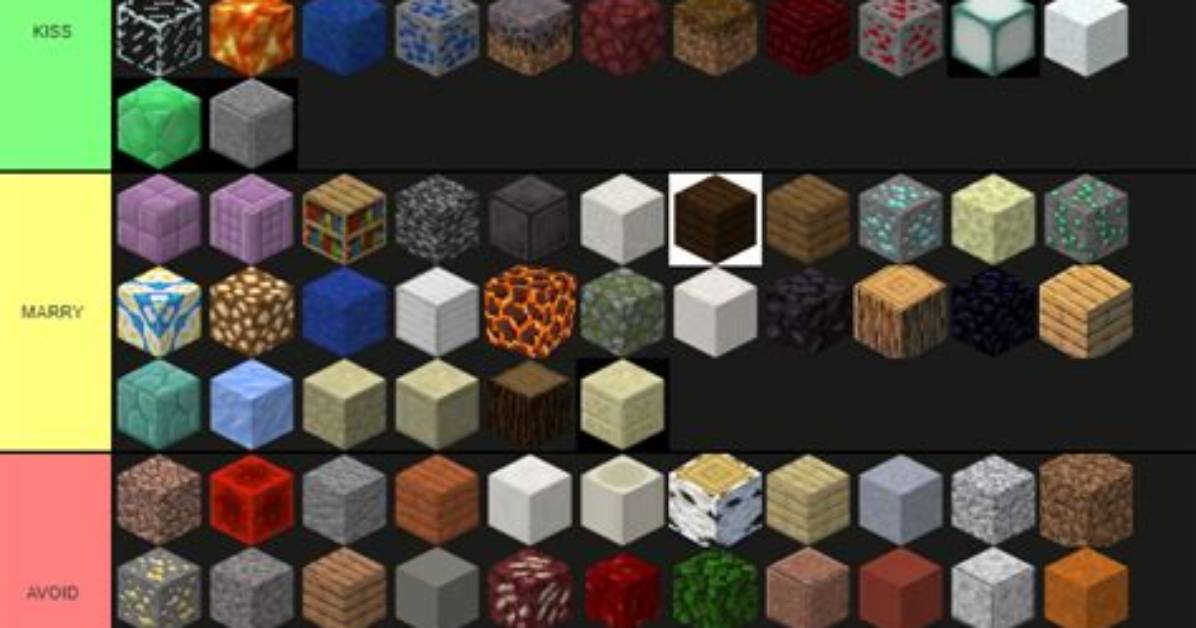
Blocks are what minecraft is all about. They’re the building pieces that make up the world you play in, and allow you to let your imagination go wild.
Almost all blocks can be aquired without using creative mode or other inventory editors. However, some blocks require a silk touch enchantment, which allows the player to harvest a block in it’s original state, rather than converting it to something else. Examples are grass blocks, which turn to dirt when you dig them up or ore blocks, which drop the ores.
A block is about a cubic meter if you’d compare it to real life, which makes a minecraft character about 1.70 meters (5′ 7″). The texture of a block is a cube of 16x16x16 pixels, but there are texture packs that have higher resolution textures.
There are over 100 different blocks, which can be divided in many different categories, like ores, plants, stones, mechanisms and many more. In this section, we’ll briefly describe each block, but for more information about the blocks or extra tips on how best to gather them, please refer to their individual articles. Some blocks could theoratically fall under more than one category, but in this section we’ve only placed each block in one category.
Natural Blocks
These blocks occur naturally in the world and are generated when each world is created. They require no player input to be made.
Air
Air blocks are invisible blocks that allow players and monsters to walk through the world. It’s impossible to get this ‘block’ without an inventory edit.
Bedrock
Bedrock is an indestructable block which covers the bottom of the Overworld and the top and bottom of the Nether. They’re meant as boundaries, giving the world a minimum and maximum height.
Clay Blocks
Often only found under the water, mostly near the edges or in the middle of lakes. Usually surrounded by sand. Clay can be dug up, causing it to drop clay which is used to make bricks or clay blocks.
Cobblestone
Cobblestone is ‘created’ when a player mines normal stone. Melting it in a furnace will recreate a normal stone block. Cobblestone can also be found as part of structures, like villager houses and dungeons.
Cracked Stone Bricks
These bricks are only found in strongholds, making their supply very limited. Despite their cracked surface, they’re not weaker than their normal or mossy counter part.
Dirt Blocks
Dirt is almost always the top layer in the Overworld. Grass and mycelium can spread onto it, but digging up either one of these will revert it to dirt.
Farmland
Though not really considered a natural block, as it requires a player to use a hoe on grass or dirt, farmland does occur in villages which are generated with the rest of the world. Farmland allows a player to plant seeds, but require a source of water to be within 4 blocks from it in order to stay fertile.
Grass Block
Grass blocks form the top most layer in almost every biome. Grass blocks are often required for mobs to spawn and grass will spread onto nearby dirt blocks. Snow can cover these blocks, but will not revert it to a dirt block.
Gravel
One of the only blocks that is affected by gravity. If it isn’t supported by other blocks, it will fall untill it hits another block. Gravel can be found in many places, both on the surface as underground, though it’s often easier to look for it underground.
Ice Blocks
Ice will form on any water during snow form, but only on water that isn’t covered by other blocks, no matter how high the block is above the water or if the water block is too close to a heat source, like a torch.
Mossy Cobblestone
Mossy cobblestone is like normal cobblestone, but with a green texture added to it, resembling moss. Mossy cobblestone can only be found in dungeons, making it one of the rarer and harder to find blocks in game.
Mossy Stone Brick
These blocks are only found in strongholds, making them hard to get and their supply is very limited.
Mycelium
Mycelium blocks are similar to grass blocks, but purple. They only occur in mushroom biomes and will spread to dirt blocks. Digging up mycelium without the silk touch enchantment will turn it into a dirt block.
Obsidian
Obsidian is created when water touches lava source blocks. Obsidian is the toughest material available to players without inventory edits and is resistant to all explosions. Obsidian is also used to create Nether portals, used to travel to the Nether, and
enchantment tables.
Sand
Sand is one of the only blocks affected by gravity and will fall down until it’s supported by other blocks. Sand can be found in every biome, but is of course most prominent in desert biomes.
Sandstone
Sandstone blocks are often the first 2-3 layers you’ll find below sand, and are of course easiest to gather in desert biomes.
Stone
Stone makes up most of the minecraft world. Mining stone will turn it into cobblestone.
Stone Bricks
These blocks are only found in stronghold, but they can also be created by the player by placing 4 stone blocks in a 2×2 square in any crafting grid.
Ores and Minerals
All ore blocks require the use of a pickaxe with the silk touch pick if you want to mine the block, instead of its ores.
Coal Ore
Coal can be found pretty much everywhere and is a common sight in every map. A wooden pickaxe is the minimum requirement to mine coal.
Diamond Ore
Diamond ore are hard to find, only occuring in the bottom 17 layers. Finding diamonds can be very difficult, but there are several tips and tricks you can use to make it a little easier.
Gold Ore
Gold ores can be found in the bottom 32 layers and aren’t too difficult to find. Gold is used in many crafted items, including armour and tools, but their durability is very low.
Iron Ore
Iron ore can be found in all layers between 64 (sea level) and bedrock. They’re very easy to find and players will often ignore them once they have a decent supply of iron.
Lapis Lazuli Ore
This blue ore is often mistaken for diamonds, which often disapoints a player. Lapis lazuli is currently only used in dyes or to create a lapis block. Lapis Lazuli ores can only be found in the bottom 33 layers.
Redstone Ore
Redstone ore is found in the bottom 16 layers and used in redstone circuits and some created items. Several pieces of redstone dust will drop from 1 ore block, which quickly gives the player a large supply of redstone.
Marcus Vance is a cybersecurity auditor and technology writer dedicated to educating the public about online safety, data privacy regulations, enterprise security, and emerging cyber threats.
