
Nlp vs Nlu: What’s the Difference?

A Natural Language Is One That Has Evolved over Time via Use and Repetition. It Does Not Involve Deliberate Planning and Strategy. Latin, English, Spanish, and...
A natural language is one that has evolved over time via use and repetition. It does not involve deliberate planning and strategy. Latin, English, Spanish, and many other spoken languages are all languages that evolved naturally over time.
Natural languages are different from formal or constructed languages, which have a different origin and development path. For example, programming languages including C, Java, Python, and many more were created for a specific reason.
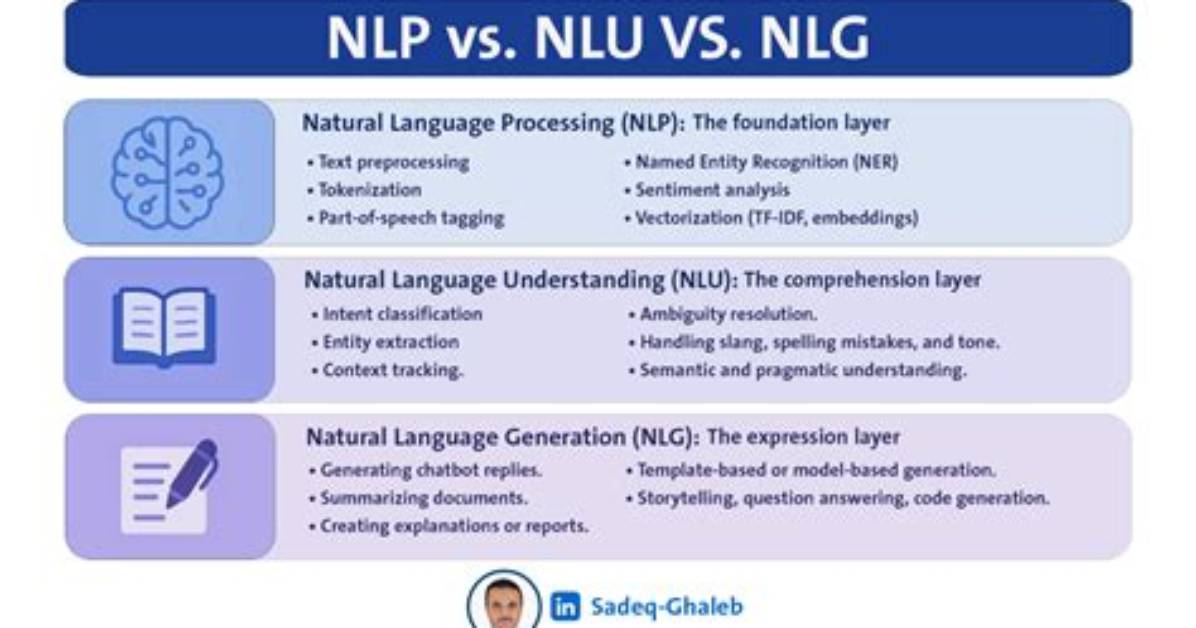
For a machine to be autonomous, a key tenet is to be able to communicate via one of the natural languages known to humans. In the wide world of Artificial Intelligence, one field deals with enabling machines to interact using these languages: Natural Language Processing (NLP).
NLP is an umbrella term which encompasses any and everything related to making machines able to process natural language—be it receiving the input, understanding the input, or generating a response.
In this context, another term which is often used as a synonym is Natural Language Understanding (NLU). Actually, though, NLP and NLU focus on different areas. In this article, we’ll look at them to understand the nuances.
What is natural language processing?
From the computer’s point of view, any natural language is a free form text. That means there are no set keywords at set positions when providing an input.
Beyond the unstructured nature, there can also be multiple ways to express something using a natural language. For example, consider these three sentences:
- How is the weather today?
- Is it going to rain today?
- Do I need to take my umbrella today?
All these sentences have the same underlying question, which is to enquire about today’s weather forecast.
As humans, we can identify such underlying similarities almost effortlessly and respond accordingly. But this is a problem for machines—any algorithm will need the input to be in a set format, and these three sentences vary in their structure and format. And if we decide to code rules for each and every combination of words in any natural language to help a machine understand, then things will get very complicated very quickly.
This is where NLP enters the picture.
NLP is a subset of AI tasked with enabling machines to interact using natural languages. The domain of NLP also ensures that machines can:
- Process large amounts of natural language data
- Derive insights and information
But before any of this natural language processing can happen, the text needs to be standardized.
In machine learning (ML) jargon, the series of steps taken are called data pre-processing. The idea is to break down the natural language text into smaller and more manageable chunks. These can then be analyzed by ML algorithms to find relations, dependencies, and context among various chunks.
Some examples of pre-processing steps are:
- Parsing
- Stop-word removal
- Part-of-speech (POS) tagging
- Tokenization
- Many more
Thus, we can sum up: The aim of NLP is to process the free form natural language text so that it gets transformed into a standardized structure.
Must Read
What is natural language understanding (NLU)?
Considered a subtopic of NLP, the main focus of natural language understanding is to make machines:
- Interpret the natural language
- Derive meaning
- Identify context
- Draw insights
For example, in NLU, various ML algorithms are used to identify the sentiment, perform Name Entity Recognition (NER), process semantics, etc. NLU algorithms often operate on text that has already been standardized by text pre-processing steps.
Going back to our weather enquiry example, it is NLU which enables the machine to understand that those three different questions have the same underlying weather forecast query. After all, different sentences can mean the same thing, and, vice versa, the same words can mean different things depending on how they are used.
Let’s take another example:
- The banks will be closed for Thanksgiving.
- The river will overflow the banks during floods.
A task called word sense disambiguation, which sits under the NLU umbrella, makes sure that the machine is able to understand the two different senses that the word “bank” is used.
Robert Thorne covers electric vehicle innovations, autonomous driving systems, global mobility trends, and automotive engineering developments.
