
Patch vs Hotfix vs Coldfix vs Bugfix: Differences Explained

Programmers Have to Be on Their a-Game to Fix Bugs, Especially Once the Software Is Live and People Are Actively Using It. Depending on the Type of Bug, You’ll...
Programmers have to be on their A-game to fix bugs, especially once the software is live and people are actively using it. Depending on the type of bug, you’ll have to decide the best way to debug it—with the least amount of impact to the user experience.
Things get even more urgent when a security vulnerability is discovered, and it’s all-hands-on-deck until a solution is implemented that will prevent successful exploitation of the system’s weakness, removing or mitigating a threat’s capability.
Finding and fixing the problem is just the first step. Then, you have to decide how to fix the problem—and how to roll it out in a way that minimizes the impact to users. That remedy might be delivered via:
- Patch
- Hotfix
- Coldfix
- Bugfix
Those terms are often used interchangeably, but there are differences in each one based on how a programmer incorporates their solution into the software.
What’s a patch?
In the early days of computing, a patch was, quite literally, a patch. Analog computers used punched cards and paper tapes to input programs the machines used for performing their calculations. These “decks” contained rows of holes and spaces that were a computer’s software, and just like today, the software suppliers would need to make changes to the programming.
These updates were distributed on smaller pieces of paper tape or punched cards, and the recipients were expected to cut the bad part of the code out of the deck and patch in the replacement segment—hence the name.
Of course, patching has come a long, digital way. Patches for today’s computers typically update existing software version’s code by modifying or replacing it using a publicly released executable program.
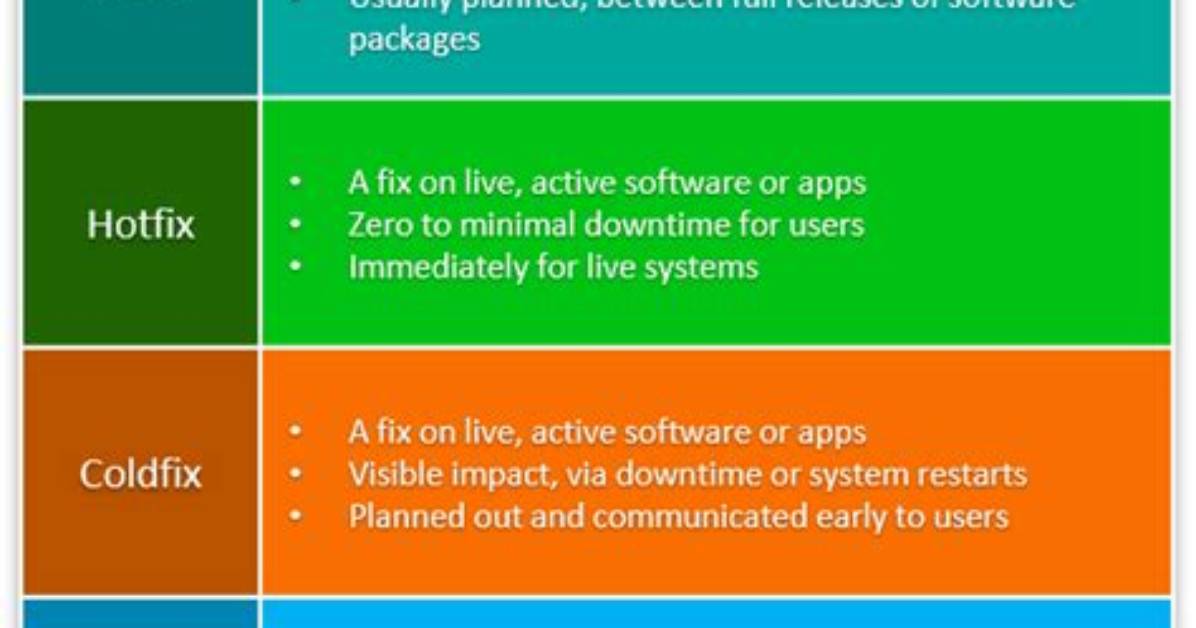
Patches are often temporary fixes between full releases of software packages. Patches are used to correct both large and small issues that may or may not require immediate attention, such as:
- Fixing a software bug
- Installing new drivers
- Addressing new security vulnerabilities
- Addressing software stability issues
- Upgrading the software
Generally, patches are automatic updates that self-install packages in various sizes, from a few kilobytes up to large patches, like those for Windows that can be over 100 Mb. And like any Windows user can confirm, the installation of certain patches (on Patch Tuesday, of course) can cause interruptions and downtimes while being installed and possibly even require a system restart or two.
Most patches are delivered on a set schedule. They can be included in the product’s new version release with additional updates and fixes.
What’s a hotfix?
Hotfixes can also solve many of the same issues as a patch, but it is applied to a “hot” system—a live system—to fix an issue:
- Immediately
- Without creating system downtimes or outages.
Hotfixes are also known as QFE updates, short for quick-fix engineering updates, a name that illustrates the urgency.
Normally, you’ll create a hotfix quickly, as an urgent measure against issues that need to be fixed immediately and outside of your normal development flow. Unlike patches, hotfixes address very specific issues like:
- Adding a new feature, bug, or security fix
- Changing database schema
Importantly, hotfixes are not always publicly released, in contrast to patches.
Here’s an example: Let’s say a bank learns that their banking app could be hacked, exploiting and revealing user data like passwords, usernames, and account information. Even if the hack hadn’t occurred yet, it’s a risk so significant that even identifying its potential requires urgent action. The security team will likely drop everything, scrambling to deliver a hotfix that solves the vulnerability as soon as possible, with minimal disruption.
James Sterling reports on renewable energy developments, climate policy, ecological conservation, and green tech innovations around the globe.
