
Python vs Rust: Choosing Your Language

Python Is One of the Most Ubiquitous and Popular Programming Languages Nowadays. It Can Power Anything from Simple Scripts and Web Applications to Data...
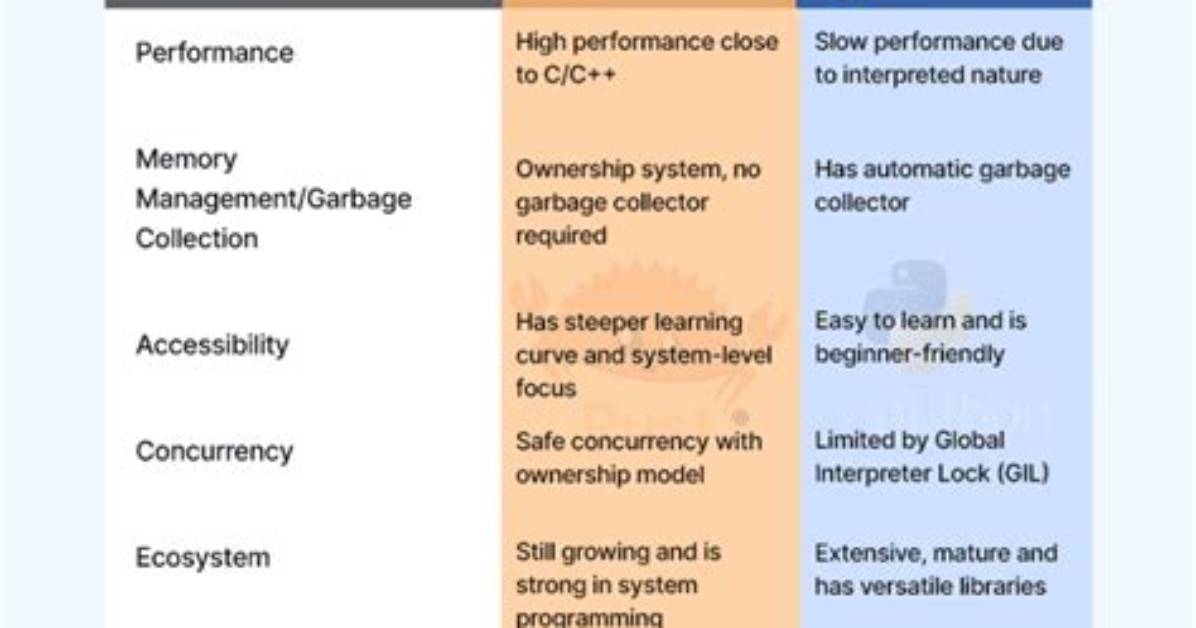
Python is one of the most ubiquitous and popular programming languages nowadays. It can power anything from simple scripts and web applications to data analytics. On the other hand, Rust is an up-and-coming programming language quickly gaining popularity in the tech community.
Both these programming languages offer their own distinct advantages and disadvantages. In this article, let’s compare how each language stacks up against the other and find the preferable language for specific development needs.
What is Python?
Python was first introduced in 1991 by Guido van Rossum. It is a multiparadigm programming language designed to be easily extensible and help users work efficiently.
Python eliminates staples of other programming languages like semicolons and curly brackets while providing a simple programming experience with a simple syntax that increases code readability. Python is considered a more beginner-friendly language due to its simplicity.
Python’s extensibility and versatility allow using it across many domains, from system administration and application development to data analytics, machine learning, and artificial intelligence development.
(See why Python is perfect for big data.)
Advantages of Python
- Python has a relatively smaller learning curve compared to other languages. It can provide a simpler development experience without compromising functionality. The asynchronous coding style allows developers to easily handle complex coding requirements.
- A massive collection of libraries and frameworks is available. Python has gained an impressive number of libraries and frameworks due to its maturity and popularity. As a developer, there is a high chance that you can find a library or framework for any kind of functionality.
- Python integrates with a wide variety of software, including enterprise applications and databases. It can be easily integrated with other languages like PHP and .NET.
Disadvantages of Python
- Python is slower compared to compiled options such as C++ and Java since it is an interpreted language.
- While Python is easy to debug, some errors won’t be shown until runtime.
(Read our comparisons of Python to Java & Go.)
Must Read
What is Rust?
Rust is a multiparadigm general-purpose programming language introduced by Graydon Hoare from Mozilla Research. Rust is focused on safety, stability, and performance. It is a statically typed programming language with a memory-efficient architecture and is C/C++ compliant.
Even though Rust is a newer language compared to Python, it has quickly gained popularity within the developer community and is the most loved technology, according to the 2021 StackOverflow developer survey. Rust can also be used in many different domains such as:
- System developments
- Web applications
- Embedded systems
- Blockchain
- Game engines
Advantages of Rust
- Rust is performance-oriented compared to other languages with its fast and memory-efficient architecture with no runtime or garbage collection.
- Enforces strict safe memory allocations and secure coding practices.
- Direct safe control over low-level resources. (Comparable to C/C++)
Disadvantages of Rust
- Relatively higher learning curve compared to languages like Python. A higher degree of coding knowledge is required to use Rust efficiently.
- Low level of monkey patching support.
- The compiler can be slow compared to other languages.
James Sterling reports on renewable energy developments, climate policy, ecological conservation, and green tech innovations around the globe.
