
Samsung Galaxy Note Edge vs Samsung Galaxy Note 3

Introductionthe Galaxy Note Series of Phablets Has Opened up the Market to Larger Devices, but as We’re Seeing More and More of These Big-Screen Phones, the...
Introduction
The Galaxy Note series of phablets has opened up the market to larger devices, but as we’re seeing more and more of these big-screen phones, the differences between them start to wash out. Samsung, the originator of the category, however, has a few tricks up its sleeve to show there are still ways to improve on the form factor and it has released the Galaxy Note Edge to show such innovation in a one-of-a-kind, limited edition device.
The Note Edge is the new thing, with a fancy, curved rim where the display wraps around the edge of the phone, giving it its name. The rim can act as a totally separate secondary display, or as a complementary one to the main screen - a peculiar new addition. For all else, though, it is nearly identical to the Note 4 - a Quad HD screen, Snapdragon 805 chip, and S Pen.
On the other hand, you have the much more traditional-looking Galaxy Note 3. Samsung stepped up to a 1080p display with the Note 3 last year, and it has also equipped it with a capable Snapdragon 800 chip, and a potent camera. The Note 3 was a device that hit all bases for its time, and we wondered whether Samsung can give its users a compelling reason to upgrade this year.
Is the Note Edge - with its curved rim and powerful silicon - such a reason? Let’s find out.
Must Read
Design
The Note Edge, with that curved rim, is a bit hard to handle, as you have to be careful to not press something on the edge accidentally. Design-wise, it has a metal frame, while the Note 3 is a less-inspiring plastic affair.
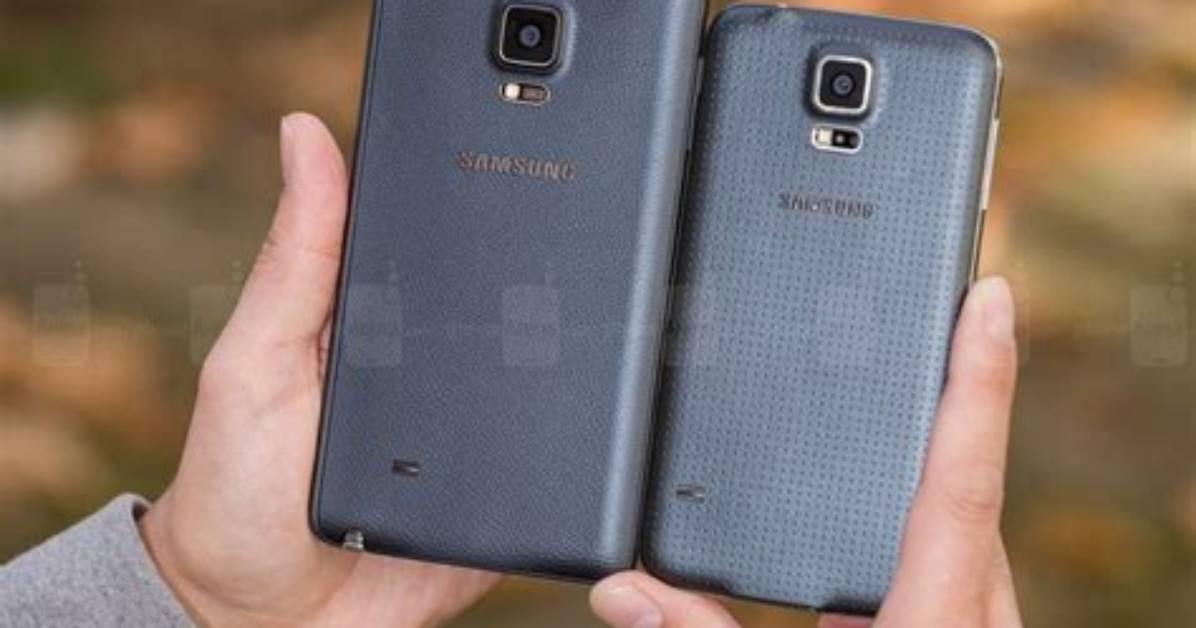
The Note Edge’s curved rim makes for a truly alien appearance of the handset, but save for that addition, the Note Edge is very similar to the Galaxy Note 4. Yes, this means that it features a similar, sturdy aluminum frame, an important advantage over the all-plastic Galaxy Note 3. The back cover of both, however, remains plastic - the Note Edge comes with a more rough, leather-like texture, while the Note 3’s faux-leather casing comes with a finer grain and a seam-like border.
The footprint of the two phablets is very similar, with the Note Edge being just slightly wider due to its edge. The exact dimensions are 5.96 x 3.24 x 0.33 inches (151.3 x 82.4 x 8.3 mm) for the Note Edge versus 5.95 x 3.12 x 0.33 inches (151.2 x 79.2 x 8.3 mm) on the Note 3.
The big difference that you might not be able to tell by just looking at dimensions, however, is in handling. Having the curved rim on the Note Edge means that you have to be careful not to touch it accidentally when you hold the device, while on the Note 3 you don’t have such worries. The Note Edge rim, however, is not completely exposed - the slight plastic bezel at its base prevents accidental touches, and after using the Note Edge for a while, you get used to not touching the side rim.
In terms of buttons, the Note Edge with its right edge occupied by the wrap-around screen, is forced to move the lock button to the top, which is definitely a hard-to-reach, inconvenient position for such an often used button. The Note 3, in comparison, has its power/lock key conveniently on the right. The volume rocker is on the left on both, and up front each has a large physical home key, but the one on the Note Edge comes with a fingerprint scanner.
Alexander Ross has covered the video game industry for a decade, writing deep dives on game design, esports tournaments, VR developments, and gaming culture.
