
What Are Rules of Exponents? What Is the Purpose of the Exponent Rules?

What Are Exponents? Exponents, Also Known as Powers or Indices, Are Mathematical Notations Used to Represent the Repeated Multiplication of a Base Number by...
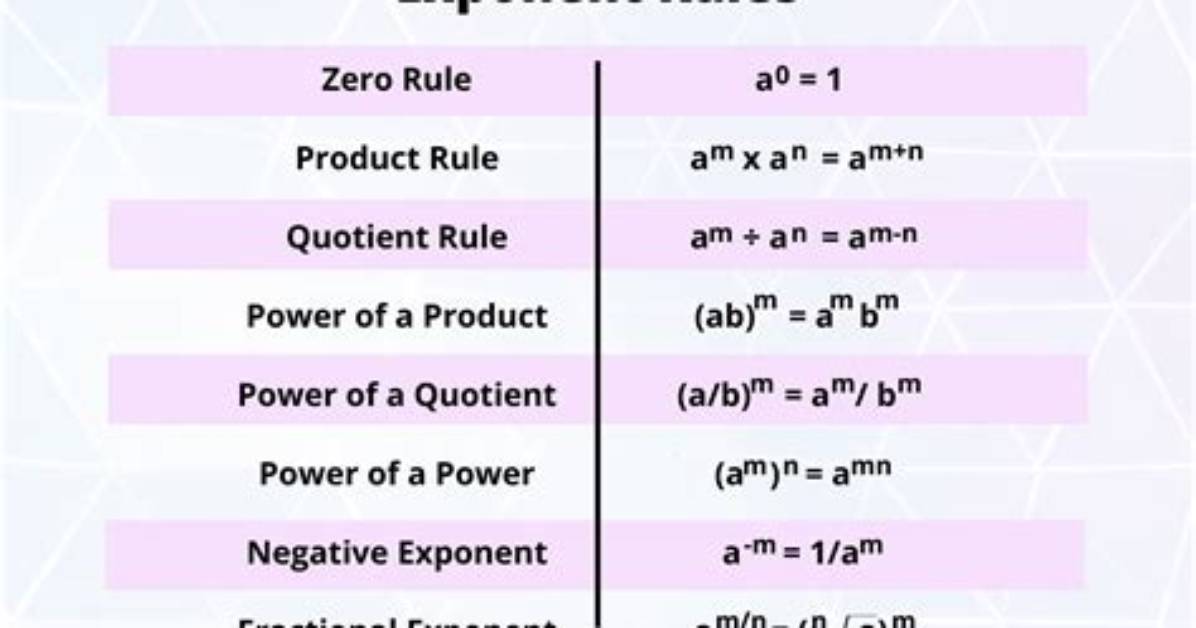
What are Exponents?
Exponents, also known as powers or indices, are mathematical notations used to represent the repeated multiplication of a base number by itself a certain number of times. An exponent is represented by a small superscript number written to the right and above a base number. For example, in the expression 2^3, the base number is 2 and the exponent is 3. This means that 2 is being multiplied by itself 3 times, or 2 * 2 * 2, which equals 8.
Exponents are used extensively in algebra and calculus to represent and manipulate expressions involving exponential functions. Exponential functions have the form f(x) = a^x, where a is a constant base number and x is the exponent. These functions describe phenomena such as population growth, radioactive decay, and signal amplification.
Exponents can be positive, negative, or zero. A positive exponent indicates that the base number is being multiplied by itself a certain number of times. A negative exponent indicates that the base number is being divided by itself a certain number of times. For example, 2^-3 is equal to 1 / (2^3), or 1/8. A zero exponent indicates that the base number is equal to 1.
Exponents obey certain rules, known as the laws of exponents or exponent rules, that make it possible to manipulate expressions involving exponential functions. These rules include the product rule, quotient rule, power rule, negative exponent rule, zero exponent rule, and product of powers rule.
In summary, exponents are a mathematical notation used to represent the repeated multiplication of a base number by itself a certain number of times. They are used extensively in algebra and calculus to represent and manipulate expressions involving exponential functions, and they obey certain rules known as the laws of exponents.
Must Read
What are Rules of Exponents?
The rules of exponents are a set of mathematical rules that simplify the way we manipulate expressions involving exponential functions. They are essential in algebra and calculus and are used to simplify equations, factorize polynomials, and solve equations involving exponential functions. There are six main rules of exponents that we will cover below:
Product rule of exponents:
a^m * a^n = a^(m+n)
The product rule states that when multiplying two exponential terms with the same base, you can add the exponents.
Example: 2^3 * 2^4 = 2^(3+4) = 2^7 = 128
Quotient rule of exponents:
a^m / a^n = a^(m-n)
The quotient rule states that when dividing two exponential terms with the same base, you can subtract the exponents.
Example: 10^6 / 10^3 = 10^(6-3) = 10^3 = 1000
Power rule of exponents:
(a^m)^n = a^(m*n)
The power rule states that when raising an exponential term to another exponent, you can multiply the exponents.
Example: (5^2)^3 = 5^(2*3) = 5^6 = 15625
Negative exponent rule:
a^(-n) = 1 / a^n
The negative exponent rule states that when an exponential term has a negative exponent, you can rewrite it as its reciprocal with a positive exponent.
Example: 2^(-4) = 1 / 2^4 = 1/16
Zero exponent rule:
a^0 = 1
The zero exponent rule states that any non-zero number raised to the power of zero is equal to one.
Example: 10^0 = 1
Product of powers rule:
(ab)^n = a^n * b^n
The product of powers rule states that when a product is raised to a power, each factor can be raised to that power.
Example: (2*3)^4 = 2^4 * 3^4 = 16 * 81 = 1296
These rules are essential in simplifying expressions involving exponential terms, and they make calculations much more efficient. By applying these rules correctly, you can simplify complicated expressions and solve equations more easily.
Elena Rostova holds a Master's degree in Public Health Journalism. She covers groundbreaking medical research, holistic wellness trends, mental health awareness, and nutritional science.
