
What Are the Boolean Algebra Laws?

Boolean Algebra Laws, Also Known as Boolean Laws or Boolean Axioms, Are a Set of Fundamental Rules That Govern the Manipulation and Simplification of Boolean...
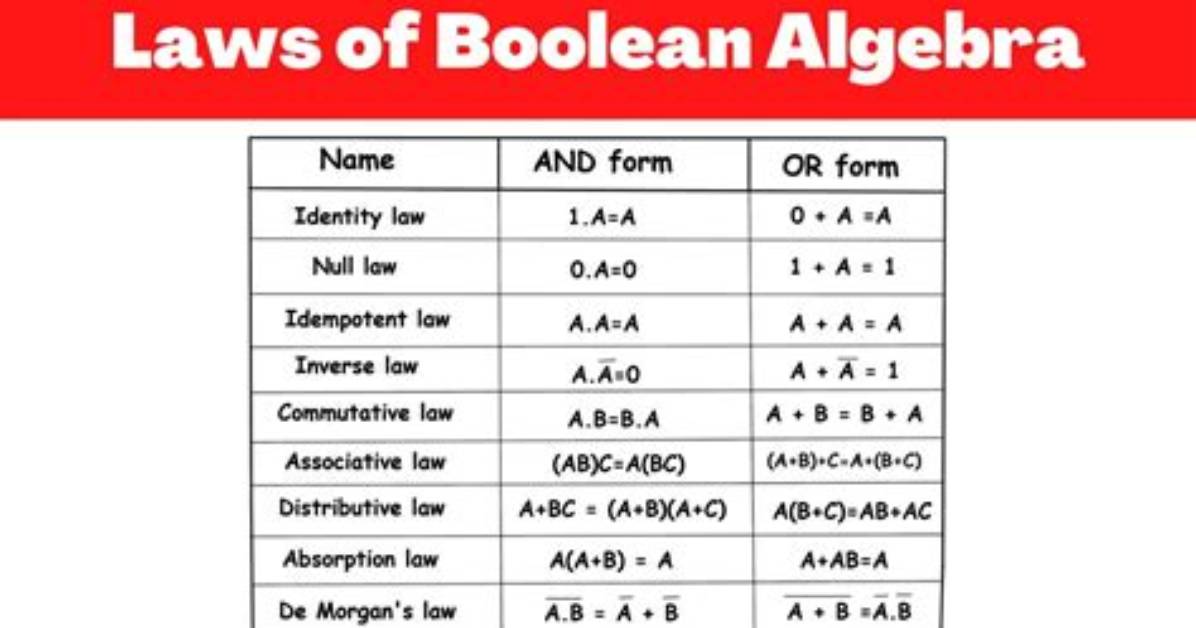
Boolean algebra laws, also known as Boolean laws or Boolean axioms, are a set of fundamental rules that govern the manipulation and simplification of Boolean expressions. These laws are essential in digital logic and computer science, as they provide a systematic way to simplify and analyze logical expressions. Here are the primary Boolean algebra laws:
Identity Laws:
- Identity Law for AND: A AND 1 = A
- Identity Law for OR: A OR 0 = A
Domination Laws:
- Domination Law for AND: A AND 0 = 0
- Domination Law for OR: A OR 1 = 1
Idempotent Laws:
- Idempotent Law for AND: A AND A = A
- Idempotent Law for OR: A OR A = A
Complement Laws:
- Complement Law for AND: A AND NOT A = 0
- Complement Law for OR: A OR NOT A = 1
Double Negation Law:
- NOT(NOT A) = A
Commutative Laws:
- Commutative Law for AND: A AND B = B AND A
- Commutative Law for OR: A OR B = B OR A
Associative Laws:
- Associative Law for AND: (A AND B) AND C = A AND (B AND C)
- Associative Law for OR: (A OR B) OR C = A OR (B OR C)
Distributive Laws:
- Distributive Law for AND over OR: A AND (B OR C) = (A AND B) OR (A AND C)
- Distributive Law for OR over AND: A OR (B AND C) = (A OR B) AND (A OR C)
De Morgan's Laws:
- De Morgan's Law for AND: NOT (A AND B) = (NOT A) OR (NOT B)
- De Morgan's Law for OR: NOT (A OR B) = (NOT A) AND (NOT B)
Absorption Laws:
- Absorption Law for AND: A AND (A OR B) = A
- Absorption Law for OR: A OR (A AND B) = A
These Boolean algebra laws provide a systematic way to simplify complex Boolean expressions and are widely used in digital circuit design, logic optimization, and computer programming. By applying these laws, you can transform logical expressions into simpler forms while preserving their logical equivalence.
What are the Various Boolean Algebra Laws?
Boolean algebra laws are a set of rules and identities that govern the manipulation and simplification of Boolean expressions. These laws are crucial in digital logic design, circuit analysis, and other areas where binary variables are used. Here are some of the fundamental Boolean algebra laws:
Identity Laws:
- Identity Law for AND: A AND 1 = A
- Identity Law for OR: A OR 0 = A
Domination Laws:
- Domination Law for AND: A AND 0 = 0
- Domination Law for OR: A OR 1 = 1
Complement Laws:
- Complement Law for AND: A AND ~A = 0
- Complement Law for OR: A OR ~A = 1
Idempotent Laws:
- Idempotent Law for AND: A AND A = A
- Idempotent Law for OR: A OR A = A
Null Laws:
- Null Law for AND: A AND 1 = A
- Null Law for OR: A OR 0 = A
Domination Laws (with Complements):
- Domination Law for AND (with complement): A AND ~A = 0
- Domination Law for OR (with complement): A OR ~A = 1
Double Negation Law:
- ~~(~A) = A
Commutative Laws:
- Commutative Law for AND: A AND B = B AND A
- Commutative Law for OR: A OR B = B OR A
Associative Laws:
- Associative Law for AND: (A AND B) AND C = A AND (B AND C)
- Associative Law for OR: (A OR B) OR C = A OR (B OR C)
Distributive Laws:
- Distributive Law for AND over OR: A AND (B OR C) = (A AND B) OR (A AND C)
- Distributive Law for OR over AND: A OR (B AND C) = (A OR B) AND (A OR C)
Absorption Laws:
- Absorption Law for AND: A AND (A OR B) = A
- Absorption Law for OR: A OR (A AND B) = A
De Morgan's Laws:
- De Morgan's Law for AND: ~(A AND B) = ~A OR ~B
- De Morgan's Law for OR: ~(A OR B) = ~A AND ~B
Consensus Theorem:
- (A AND B) OR (C AND D) OR (A AND D) = (A AND B) OR (C AND D)
These laws form the foundation of Boolean algebra and provide tools to simplify, manipulate, and analyze Boolean expressions and logic circuits effectively. They are essential for both theoretical understanding and practical applications in digital logic design and computer science.
Must Read
What is Boolean Algebra?
Boolean algebra is a branch of mathematics and a fundamental concept in computer science and digital electronics. It deals with a system of algebraic operations and rules applied to binary variables, which can take on one of two possible values: true (often represented as 1) or false (often represented as 0). Boolean algebra is named after George Boole, an English mathematician who developed the foundation of this algebraic system in the mid-19th century.
Boolean algebra consists of several fundamental operations:
- AND (Conjunction): The AND operation takes two binary inputs and produces an output that is true (1) only if both inputs are true (1).
- OR (Disjunction): The OR operation takes two binary inputs and produces an output that is true (1) if at least one of the inputs is true (1).
- NOT (Negation): The NOT operation takes a single binary input and produces the opposite value. If the input is true (1), the output is false (0), and vice versa.
- XOR (Exclusive OR): The XOR operation takes two binary inputs and produces an output that is true (1) if the inputs are different (one is true and the other is false).
These operations can be combined to create more complex expressions, and Boolean algebra follows specific rules and laws, such as the distributive law, commutative law, associative law, and others. These laws are similar to the laws of ordinary algebra, but with some differences due to the binary nature of Boolean variables.
Elena Rostova holds a Master's degree in Public Health Journalism. She covers groundbreaking medical research, holistic wellness trends, mental health awareness, and nutritional science.
