
What Are the Multiples of 29 (Properties and Examples)

Gain a Deeper Understanding of the Multiples of 29 as We Explore Their Properties and Provide Practical Examples. Elevate Your Mathematical Knowledge with This...
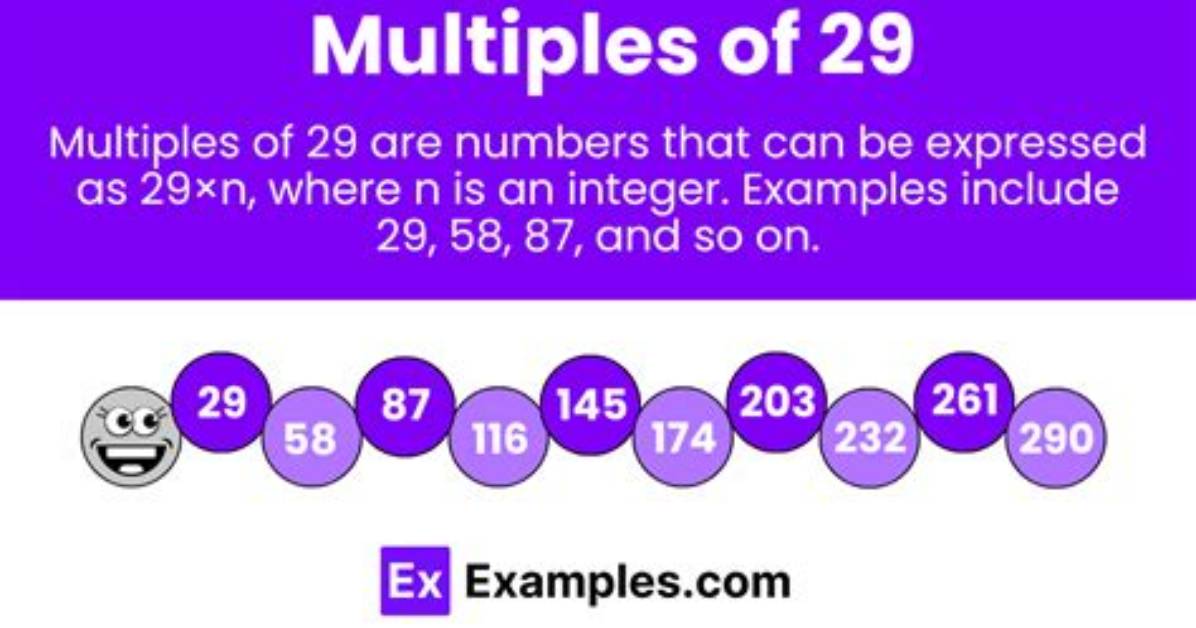
Gain a deeper understanding of the multiples of 29 as we explore their properties and provide practical examples. Elevate your mathematical knowledge with this insightful exploration.
What are the Multiples of 29?
The multiples of 29 are the numbers that can be obtained by multiplying 29 by any positive integer. Let's explore these multiples and delve into the properties of this prime number.
Firstly, 29 is a prime number, which means it is only divisible by 1 and 29 itself. This characteristic makes the multiples of 29 relatively straightforward to identify. The first few multiples of 29 include 29, 58, 87, 116, and so on. To find these multiples, one simply multiplies 29 by consecutive positive integers.
The pattern of multiples continues indefinitely, with each subsequent multiple being 29 more than the previous one. The formula for finding the nth multiple of 29 is given by 29n, where n is a positive integer.
For example, the first five multiples are obtained as follows:
- 1st multiple: 29 × 1 = 29
- 2nd multiple: 29 × 2 = 58
- 3rd multiple: 29 × 3 = 87
- 4th multiple: 29 × 4 = 116
- 5th multiple: 29 × 5 = 145
As you can see, each multiple is generated by multiplying 29 by the corresponding positive integer.
Multiples play a significant role in various mathematical concepts and applications, such as finding common denominators, determining patterns in sequences, and solving problems in number theory. Understanding the multiples of prime numbers, like 29, is fundamental in mathematics and has practical implications in fields such as cryptography, where prime numbers are essential for ensuring the security of certain algorithms.
Must Read
What is a Multiple?
In mathematics, a multiple is a number that can be obtained by multiplying another number (the base number) by an integer (the multiplier). In other words, a multiple is the product of a base number and any whole number (including 0).
Here are some key points about multiples:
- Definition: If b = n * a, where n is any integer and a is not zero, then b is a multiple of a.
- Equivalent definition: If b/a is an integer without any remainder, then b is a multiple of a.
- Examples:
- 12 is a multiple of 3 because 12 = 3 * 4.
- 20 is a multiple of 5 because 20 = 5 * 4.
- 0 is a multiple of any number because 0 * n = 0 for any integer n.
- Properties:
- Every integer is a multiple of 1.
- Every integer is a multiple of itself.
- The set of multiples of a given number is infinite.
Understanding multiples is essential in various mathematical concepts like divisibility, least common multiple, and greatest common factor. They are also widely used in real-world scenarios, such as calculating time, measurements, and financial transactions.
Chloe Bennett explores the intersection of pop culture, streaming entertainment, digital trends, and contemporary lifestyle. Her weekly commentary reaches thousands of culture enthusiasts.
