
What Is a Concave Polygon?

A Concave Polygon Is a Polygon with at Least One Interior Angle Greater Than 180 Degrees. in Other Words, It's a Polygon Where the Interior Angles "Bend...
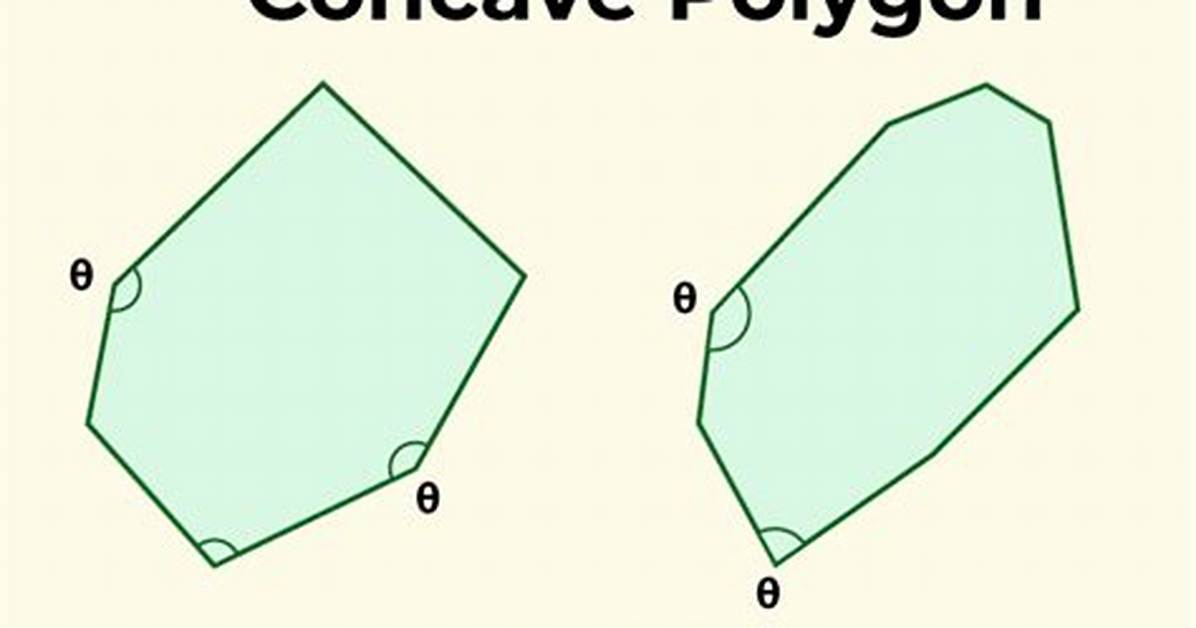
A concave polygon is a polygon with at least one interior angle greater than 180 degrees. In other words, it's a polygon where the interior angles "bend inward" rather than all of them "pointing outward." This means that some of the vertices of a concave polygon "push" into the interior of the shape, causing the interior angles to exceed 180 degrees.
In contrast, a convex polygon is a polygon where all of its interior angles are less than 180 degrees, and none of its vertices push into the interior of the shape.
Here's a simple example to help illustrate the difference:
A convex polygon: A regular pentagon (a five-sided shape) where all interior angles are less than 180 degrees.
A concave polygon: An irregular hexagon (a six-sided shape) where one of the interior angles measures more than 180 degrees. For example, if one of the angles between two consecutive sides is 200 degrees, then the hexagon is concave.
In a concave polygon, you can often find a "notch" or indentation where the interior angle exceeds 180 degrees. Convex polygons, on the other hand, have no such notches, and their interior angles are always less than 180 degrees.
What is a Concave Polygon with Example?
A concave polygon is a polygon that has at least one interior angle greater than 180 degrees. In other words, it is a polygon with one or more "dents" or "indentations" in its shape. These indentations are often called concave vertices.
Here's an example of a concave polygon:
Example: Concave Quadrilateral
Consider a quadrilateral with the following vertices in clockwise order: A(0,0), B(4,2), C(2,4), and D(1,2).
If you connect these vertices to form the edges of the quadrilateral and calculate the interior angles, you will find that one of the angles, such as angle BCD, is greater than 180 degrees. This makes the quadrilateral a concave polygon.
To determine whether a polygon is concave or not, you can check each interior angle. If any of them is greater than 180 degrees, the polygon is concave; otherwise, it's convex. In the example above, angle BCD is greater than 180 degrees, so the quadrilateral is concave.
Must Read
What is a 4 Sided Concave Polygon?
A four-sided concave polygon is a geometric shape with four sides (quadrilateral) where at least one of the interior angles is greater than 180 degrees, causing the polygon to curve inward or "cave in" rather than being convex (where all interior angles are less than 180 degrees).
One common example of a four-sided concave polygon is a kite. A kite has two pairs of adjacent sides that are congruent (of equal length), but its interior angles are not all less than 180 degrees. Specifically, the two angles between the longer pair of sides are greater than 180 degrees, making the kite a concave quadrilateral.
Here's a simple diagram of a concave kite:
/ /
/ /
/ /
/___/_________
In this diagram, the angles between the longer sides (the top and bottom sides) are greater than 180 degrees, indicating the concavity of the kite-shaped polygon.
Sarah Jenkins is a veteran tech journalist with over 12 years of experience covering artificial intelligence, mobile innovations, and digital ethics. Her insights have appeared in leading technology publications worldwide.
