
What Is a Cyclic Quadrilateral?

A Cyclic Quadrilateral Is a Four-Sided Polygon Whose Vertices Lie on a Common Circle. in Other Words, If You Can Draw a Circle That Passes Through All Four...
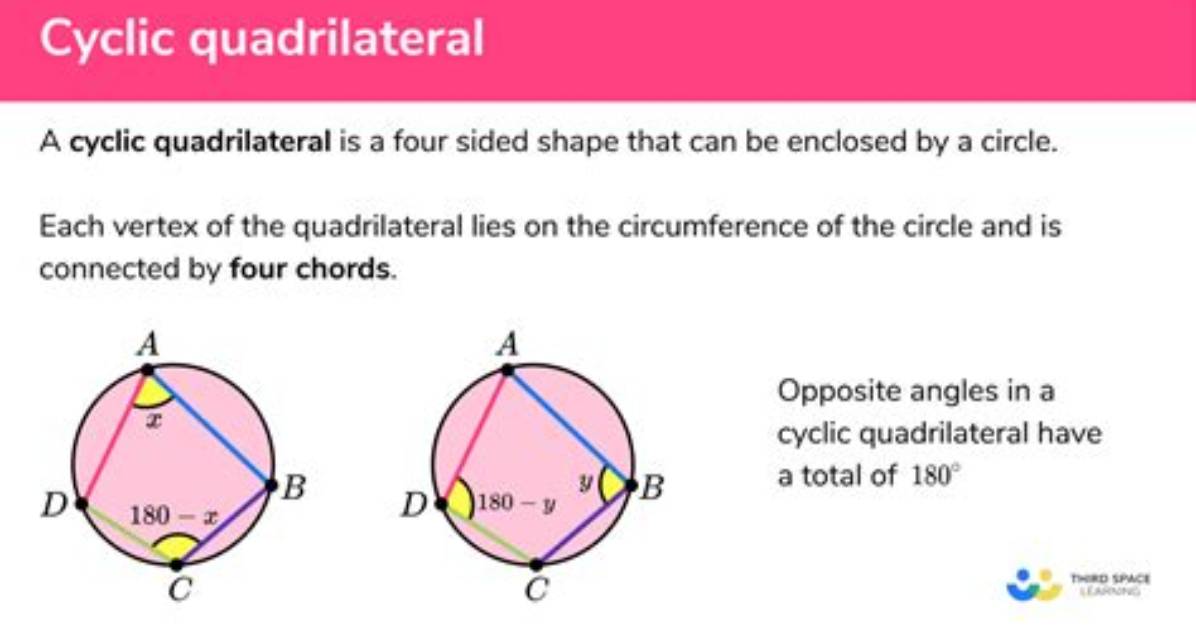
A cyclic quadrilateral is a four-sided polygon whose vertices lie on a common circle. In other words, if you can draw a circle that passes through all four vertices of a quadrilateral, then that quadrilateral is said to be cyclic.
Cyclic quadrilaterals have several interesting properties. One of the most well-known properties is that the opposite angles of a cyclic quadrilateral are supplementary, which means that the sum of the measures of two opposite angles is always 180 degrees. This property can be proven using the fact that the angles subtended by the same arc on a circle are equal.
In addition to the property of opposite angles being supplementary, cyclic quadrilaterals also have other properties related to their side lengths and diagonals. For example, the product of the lengths of the diagonals of a cyclic quadrilateral is equal to the sum of the products of the lengths of its opposite sides. This property is known as Ptolemy's theorem.
Cyclic quadrilaterals appear in various geometric problems and constructions, and their properties make them useful in solving these problems. They can also be found in many real-life applications, such as in engineering, architecture, and navigation.
What is the Property of a Cyclic Quadrilateral?
Cyclic quadrilaterals possess several important properties:
Opposite angles: The opposite angles of a cyclic quadrilateral are supplementary. This means that the sum of the measures of two opposite angles is always 180 degrees. For example, if angles A and C are opposite angles in a cyclic quadrilateral, then A + C = 180 degrees.
Consecutive angles: The sum of any two consecutive angles in a cyclic quadrilateral is always 180 degrees. This property follows from the fact that the opposite angles are supplementary.
Ptolemy's theorem: Ptolemy's theorem states that for a cyclic quadrilateral with side lengths a, b, c, and d, and diagonals e and f, the following relationship holds:
- ab + cd = ef
This theorem relates the lengths of the sides and diagonals of a cyclic quadrilateral.
Inscribed angles: The angles inside a cyclic quadrilateral that are subtended by the same arc as angles outside the quadrilateral have a special relationship. If an angle inside the cyclic quadrilateral is subtended by the same arc as an angle outside the quadrilateral, then the sum of the two angles is 180 degrees. This property can be derived from the fact that the opposite angles of a cyclic quadrilateral are supplementary.
These properties of cyclic quadrilaterals are useful in solving geometric problems involving angles, side lengths, and diagonals within the quadrilateral.
Must Read
Cyclic Quadrilateral Angles
In a cyclic quadrilateral, the sum of the measures of the opposite angles is always 180 degrees. This property can be stated as follows:
Let ABCD be a cyclic quadrilateral with angles A, B, C, and D. Then:
- Angle A + Angle C = 180 degrees
- Angle B + Angle D = 180 degrees
This property holds true for any cyclic quadrilateral, regardless of the lengths of its sides or the measures of its other angles.
Additionally, it's worth noting that the sum of all four angles in any quadrilateral, including a cyclic quadrilateral, is always 360 degrees. Therefore, in a cyclic quadrilateral, we can also state:
- Angle A + Angle B + Angle C + Angle D = 360 degrees
These properties are fundamental to understanding the relationships between the angles in a cyclic quadrilateral and can be utilised in various geometric problem-solving scenarios.
Robert Thorne covers electric vehicle innovations, autonomous driving systems, global mobility trends, and automotive engineering developments.
