
What Is the Distance Formula?

The Distance Formula Is a Mathematical Formula Used to Calculate the Distance Between Two Points in a Cartesian Coordinate System, Typically in a...
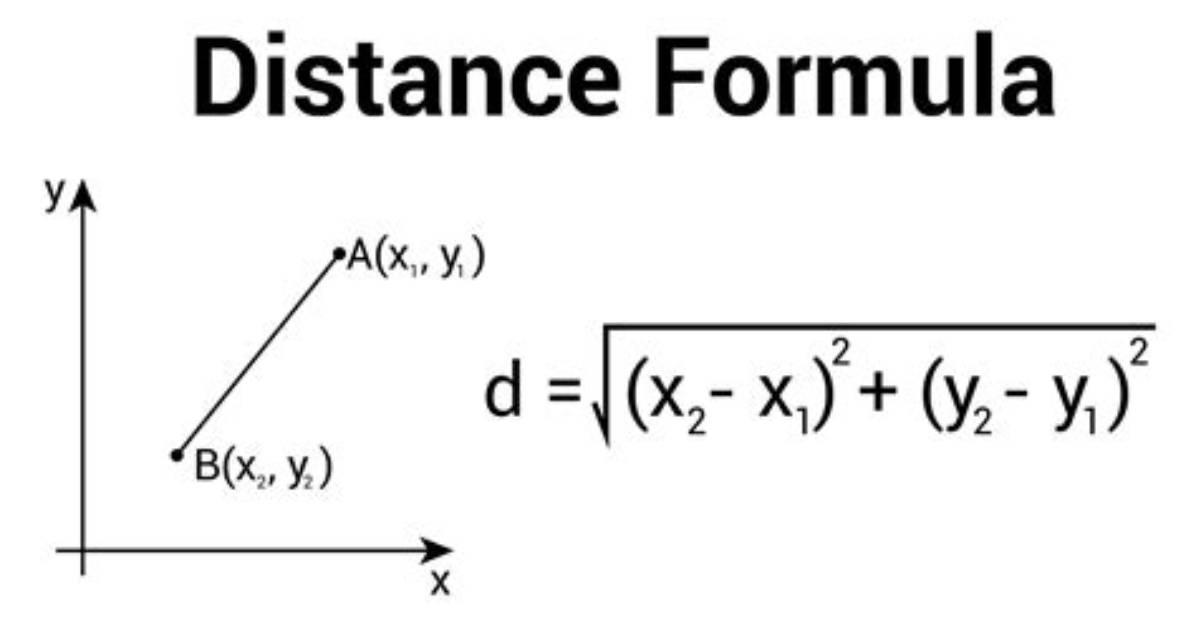
The Distance Formula is a mathematical formula used to calculate the distance between two points in a Cartesian coordinate system, typically in a two-dimensional plane (x, y) or three-dimensional space (x, y, z). It is often denoted as "d" and is expressed as:
For two points in a two-dimensional plane with coordinates (x1, y1) and (x2, y2):
- d = √((x2 - x1)² + (y2 - y1)²)
For two points in three-dimensional space with coordinates (x1, y1, z1) and (x2, y2, z2):
- d = √((x2 - x1)² + (y2 - y1)² + (z2 - z1)²)
In words, you calculate the distance by taking the square root of the sum of the squares of the differences between the corresponding coordinates of the two points. This formula can be extended to higher dimensions as needed.
The Distance Formula is quite useful in various fields of mathematics, science, engineering, and practical applications, such as measuring distances between locations on maps, determining the lengths of line segments, and solving geometry and physics problems that involve distance calculations.
How to Find the Distance Formula?
The distance formula is a mathematical formula used to calculate the distance between two points in a Cartesian coordinate system (a plane or a three-dimensional space). The formula is based on the Pythagorean theorem. Here's how to find and use the distance formula:
Distance Formula (2D):
The distance between two points (x1, y1) and (x2, y2) in a 2D plane is given by:
- Distance = √((x2 - x1)^2 + (y2 - y1)^2)
Distance Formula (3D):
In a 3D space, the distance between two points (x1, y1, z1) and (x2, y2, z2) is given by:
- Distance = √((x2 - x1)^2 + (y2 - y1)^2 + (z2 - z1)^2)
Here's how to use the distance formula:
Identify the Coordinates: Determine the coordinates of the two points for which you want to find the distance. For 2D, you need (x1, y1) and (x2, y2), and for 3D, you need (x1, y1, z1) and (x2, y2, z2).
Plug the Coordinates into the Formula: Substitute the values of the coordinates into the distance formula.
For 2D: Distance = √((x2 - x1)^2 + (y2 - y1)^2)
For 3D: Distance = √((x2 - x1)^2 + (y2 - y1)^2 + (z2 - z1)^2)
Calculate the Distances: Perform the arithmetic operations inside the square root, then calculate the square root to find the distance.
For 2D: Distance = √((x2 - x1)^2 + (y2 - y1)^2)
For 3D: Distance = √((x2 - x1)^2 + (y2 - y1)^2 + (z2 - z1)^2)
Simplify and Round: Simplify the expression if necessary and round the result to the desired level of precision.
Here's an example:
2D Distance Example:
Given two points A(3, 4) and B(7, 1), find the distance between them.
Distance = √((7 - 3)^2 + (1 - 4)^2)
Distance = √(4^2 + (-3)^2)
Distance = √(16 + 9)
Distance = √25
Distance = 5 units
So, the distance between points A and B is 5 units.
3D Distance Example:
Given two points P(2, -1, 3) and Q(5, 3, -2), find the distance between them.
Distance = √((5 - 2)^2 + (3 - (-1))^2 + (-2 - 3)^2)
Distance = √(3^2 + 4^2 + (-5)^2)
Distance = √(9 + 16 + 25)
Distance = √50
So, the distance between points P and Q in 3D space is √50 units, which is approximately 7.07 units (rounded to two decimal places).
Distance From a Point To a Line
The distance from a point to a line can be calculated using various methods, but one of the most commonly used methods is the formula for the perpendicular distance from a point to a line in a Cartesian coordinate system. Here's how you can calculate it:
Let's assume you have a point P with coordinates (x₀, y₀) and a line in the form of Ax + By + C = 0, where A, B, and C are constants.
Calculate the distance using the formula:
Distance = |Ax₀ + By₀ + C| / √(A^2 + B^2)
Here's a step-by-step breakdown of the formula:
a. Calculate the numerator, which is the absolute value of Ax₀ + By₀ + C.
b. Calculate the denominator, which is the square root of (A^2 + B^2).
c. Divide the numerator by the denominator to get the distance.
Interpretation of the formula:
- The numerator Ax₀ + By₀ + C represents the signed distance from the point (x₀, y₀) to the line. It's positive if the point is on the same side of the line as the line's normal vector (A, B) and negative if it's on the opposite side.
- The denominator √(A^2 + B^2) is the length of the line's normal vector (A, B), which is used to normalize the result, ensuring that the distance is independent of the scale of A and B.
This formula provides the shortest distance from the point to the line, and it works in two or three dimensions. If the line is given in parametric form or if you are working in a different coordinate system, the method of calculation may vary, but the concept of finding the perpendicular distance remains the same.
Sarah Jenkins is a veteran tech journalist with over 12 years of experience covering artificial intelligence, mobile innovations, and digital ethics. Her insights have appeared in leading technology publications worldwide.
