
What Will Be the Compound Interest on a Sum of Rs. 25,000 After 3 Year's at the Rate of 12 P. C. P. A. ?

You Can Use the Formula: a = P(1 + R/N)^(Nt)Where: a = the Future Value of the Investment/Loan, Including Interest P = the Principal Investment Amount (The...
What will be the Compound interest on a sum of Rs. 25,000 after 3 years at the rate of 12 p.c.p.a.?
To calculate compound interest, you can use the formula:
A = P(1 + r/n)^(nt)
Where: A = the future value of the investment/loan, including interest P = the principal investment amount (the initial deposit or loan amount) r = the annual interest rate (in decimal) n = the number of times that interest is compounded per unit t t = the time the money is invested for in years
Given: P = Rs. 25,000 r = 12% per annum = 0.12 n = 1 (compounded annually) t = 3 years
Plug the values into the formula:
A = 25000(1 + 0.12/1)^(1*3)
= 25000(1.12)^3
≈ 25000 * 1.404928
≈ Rs. 35,123.20
Now, to find the compound interest, subtract the principal amount from the future amount:
Compound Interest = Future Amount - Principal Amount = Rs. 35,123.20 - Rs. 25,000
= Rs. 10,123.20
So, the compound interest on a sum of Rs. 25,000 after 3 years at the rate of 12% per annum compounded annually would be approximately Rs. 10,123.20.
Must Read
What is Compound Interest?
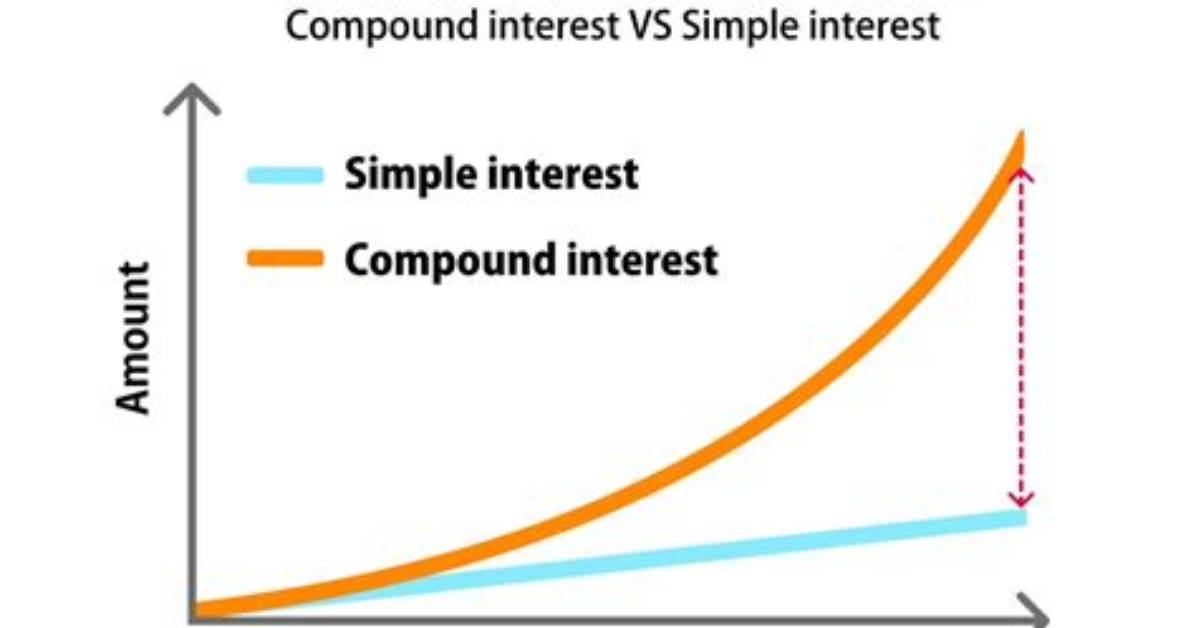
Compound interest is often referred to as "interest on interest" because it's the interest earned on both the initial principal amount (the money you deposit) and the accumulated interest from previous periods. It's essentially like a snowball effect, where your money grows at an increasingly faster rate over time.
Here's a breakdown of the key points:
- Regular interest: With regular interest, you only earn interest on the initial principal amount. So, let's say you deposit $1,000 at a 5% annual interest rate. After one year, you'll earn $50 in interest, bringing your total balance to $1,050.
- Compound interest: In contrast, with compound interest, the interest earned in each period is added to the principal amount for the next period's calculation. So, in the same example, if the interest is compounded annually, in year two you'll earn 5% interest on both the original $1,000 and the $50 interest you earned in year one, for a total of $52.50. This brings your balance to $1,102.50.
Here are some important things to know about compound interest:
- Time is your friend: The longer your money is invested and compounded, the greater the impact. Even small starting amounts can grow significantly over time thanks to compounding.
- Frequency of compounding: The more frequently interest is compounded, the faster your money grows. Daily compounding will result in greater growth compared to annual compounding.
- Interest rate: Naturally, a higher interest rate leads to faster growth.
- Double-edged sword: While compound interest can be beneficial for savings and investments, it can also work against you with debt.
Marcus Vance is a cybersecurity auditor and technology writer dedicated to educating the public about online safety, data privacy regulations, enterprise security, and emerging cyber threats.
