
Agile vs Devops: a Full Comparison

Agile and Devops Are the Two Most Popular Software Development Lifecycle (Sdlc) Methodologies Currently in Practice. One Survey Indicates That 97% of...
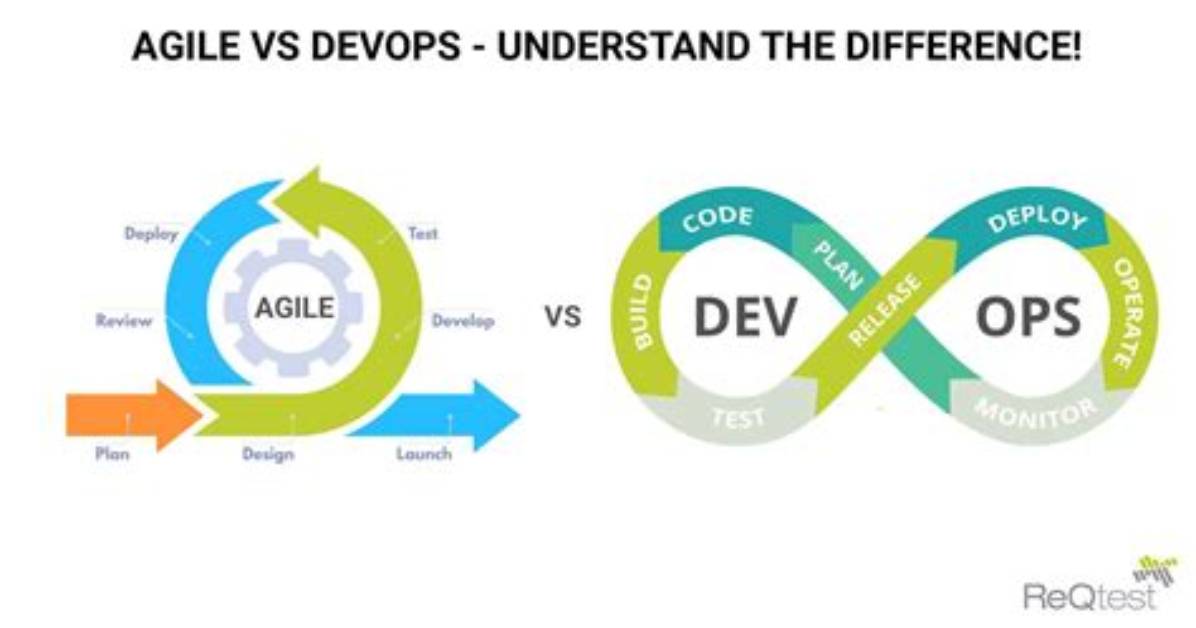
Agile and DevOps are the two most popular software development lifecycle (SDLC) methodologies currently in practice.
One survey indicates that 97% of organizations use Agile, whereas the most innovative startup firms as well as large enterprises take advantage of DevOps to deploy new code features really fast:
- AWS deploys new code every 11.7 seconds.
- Netflix deploys new code thousands of times every day!
As more organizations are eager to follow suit, it’s important to carefully understand the similarities and differences between Agile and DevOps—which is exactly what this article will help you do. We will:
- Briefly review the history of both SDLC models
- Understand the driving factors behind Agile and DevOps
- Highlight the key differences in the two
Agile origins: From Waterfall to Agile
Let’s with a recap of software development history. As software development projects grew in scale and complexity, IT organizations needed a systematic approach to consistently deliver high quality software at speed, while minimizing risk and cost overruns.
In the 1970s, the IT industry and academia formally adopted the Waterfall SDLC model: a linear and sequential model that flows through various stages of a standard software development project in the following order:
- Requirements Gathering and Analysis
- System Design
- Implementation
- Integration and Testing
- Deployment
- Maintenance
Originating in the 1950s manufacturing industry, the Waterfall model worked well enough until most organizations identified a few critical flaws when they actually implemented it. Common flaws of the Waterfall model include:
- Rigidity. Requirements cannot be changed once the development process starts.
- Risk. Any flaw or inadequacy in the product is identified only at the end of the SDLC pipeline when the project takes its final shape.
- Waste. The sequential approach is slow and channels the bottleneck across the SDLC.
- Scope. In practice, the cost and time spent on waterfall projects frequently exceeds the expected limitations.
In 2001, a team of professional developers released the Agile Manifesto: a set of values and guiding principles that can be used as a philosophy or a mindset to develop high quality software components iteratively—small but frequent releases with small improvements.
Consider how the values of Agile (left) differentiate from the traditional SDLC practices and priorities (right):
- Individuals and interactions over processes and tools
- Working software over comprehensive documentation
- Customer collaboration over contract negotiation
- Responding to change over following a plan
Agile also destroys the idea of a “finished product”, which was the goal of the Waterfall approach. Instead, Agile believes that software development is iterative and incremental. With each new release of software, the customer is able to either:
- Perform new functions
- Improve upon existing functions
Agile methodologies encourage developers to break down software development into small pieces known as “user stories”. This highlights the value Agile places on the customer, which helps the developers by both:
- Providing faster feedback loops
- Ensuring product alignment with market need
Agile further advocates for adaptive planning, evolving development, early and continuous delivery, and continuous improvement—these all enable developers to rapidly and flexibly respond to change in client needs, software, or other external factors.
(Read our in-depth Waterfall vs Agile explainer.)
Must Read
From Agile to DevOps
Agile sounds good in theory.
In fact, Agile is easy to plan. It’s easy to consider as a philosophy for organizational culture and communication among development teams. Frameworks such as Scrum make it easier to adopt Agile principles.
In practice, however, Agile lacks in execution and delivery. Organizations often agree to follow rapid release cycles and conduct regular Scrum meetings, but find it challenging to adopt Agile.
One of the reasons? Agile as a guiding manifesto brings little practical advice as an SDLC process framework in itself. Slow and tedious governance process, inadequate communication and collaboration, lack of automation and, most importantly, the expanding divide between Devs and Ops personnel keeps organizations from becoming truly Agile.
Instead, developers end up practicing sprints of fast Waterfall: siloed, sequential, discontinuous development sprints that fail to iteratively improve on customer feedback.
As IT became essential to businesses in the 21st century, two imperative areas emerged: IT Operations (ITOps) and Development Operations (DevOps):
- ITOps responsibilities include ensuring security, compliance, and reliability.
- DevOps is responsible for developing and deploying new products to the end user.
While ITOps ensures safety and security for all business needs using the network, DevOps walks a line between flexibility and the rigorous testing and communication that comes with deploying new software.
DevOps is a theory rooted in communication, both within itself—as the developers and operators have to coordinate—and also across other departments. DevOps frequently communicates with ITOps to ensure secure and stable environments for testing. Their crossover to other teams like marketing and customer service makes sense as they deploy new software.
(Explore our multi-part DevOps Guide.)
Robert Thorne covers electric vehicle innovations, autonomous driving systems, global mobility trends, and automotive engineering developments.
