
Difference Between Rational & Irrational Numbers

Rational and Irrational Numbers Are Two Distinct Types of Real Numbers in Mathematics. Here Are the Key Differences Between Them:1. Definition: Rational...
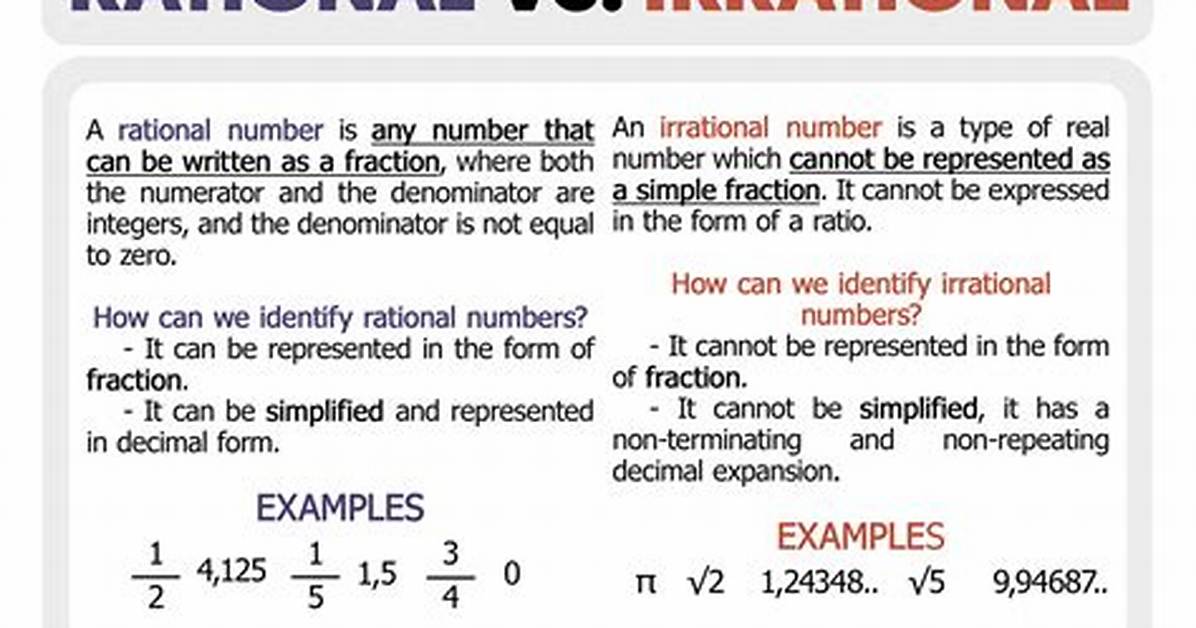
Rational and irrational numbers are two distinct types of real numbers in mathematics. Here are the key differences between them:
1. Definition:
Rational Numbers: A rational number is any number that can be expressed as the quotient or fraction of two integers, where the denominator is not zero. In other words, it can be written in the form a/b, where "a" and "b" are integers and "b" is not equal to zero. Examples of rational numbers include 1/2, -3/4, 7, and 0.
Irrational Numbers: An irrational number is a number that cannot be expressed as a simple fraction or quotient of two integers. These numbers have non-repeating, non-terminating decimal expansions. Examples of irrational numbers include the square root of 2 (√2), pi (π), and Euler's number (e).
2. Decimal Representation:
Rational Numbers: Rational numbers always have either a finite or a repeating decimal representation. For example, 1/4 is a rational number with a finite decimal representation of 0.25, while 1/3 is a rational number with a repeating decimal representation of 0.3333...
Irrational Numbers: Irrational numbers have non-repeating, non-terminating decimal expansions. For example, the decimal representation of √2 is 1.414213562..., and it goes on indefinitely without repeating.
3. Closure under Operations:
Rational Numbers: The sum, difference, product, and quotient of two rational numbers are also rational numbers, as long as the denominator of the quotient is not zero.
Irrational Numbers: Operations involving irrational numbers may or may not result in an irrational number. For example, the sum of two irrational numbers can be rational (e.g., √2 + √2 = 2√2), rationalising the denominator can sometimes result in rational numbers, and so on.
4. Countability:
Rational Numbers: The set of rational numbers is countable, which means that they can be put into a one-to-one correspondence with the set of natural numbers (1, 2, 3, ...). There is a systematic way to list all rational numbers.
Irrational Numbers: The set of irrational numbers is uncountable, meaning there are more irrational numbers than natural numbers. They cannot be listed in a systematic way, and their existence was proven by Georg Cantor in the late 19th century.
In summary, rational numbers can be expressed as fractions of integers with finite or repeating decimal representations, while irrational numbers cannot be expressed as such and have non-repeating, non-terminating decimal expansions. Both types of numbers are essential in mathematics and play different roles in various mathematical contexts.
What are Rational Numbers?
Rational numbers are a class of numbers in mathematics that can be expressed as the quotient or fraction of two integers, where the denominator (the bottom number) is not zero. In other words, a rational number is any number that can be written in the form a/b, where "a" and "b" are integers, and "b" is not equal to zero. Here are some key characteristics and examples of rational numbers:
Fractional Form: Rational numbers are typically represented as fractions, where the numerator (the top number) and denominator are integers. For example, 1/2, -3/4, and 7/1 are all rational numbers.
Terminating or Repeating Decimals: Rational numbers can also be expressed as decimals. When you divide one integer by another, the result will either be a terminating decimal (e.g., 0.5, -0.75) or a repeating decimal (e.g., 1.333..., -0.666...). The repeating decimals have a pattern of digits that repeats infinitely.
Examples: Here are some examples of rational numbers:
1/3 (a fraction)
0.25 (a terminating decimal)
-2.5 (a terminating decimal)
4 (an integer, which can be expressed as 4/1)
Closure Property: Rational numbers are closed under addition, subtraction, multiplication, and division. This means that when you add, subtract, multiply, or divide two rational numbers, the result is always another rational number.
Order: Rational numbers can be ordered on the number line. They can be greater than, less than, or equal to each other. For example, 1/2 is less than 3/4.
Rational vs. Irrational Numbers: Rational numbers are distinct from irrational numbers. Irrational numbers cannot be expressed as a simple fraction of two integers and have non-repeating, non-terminating decimal representations. Examples of irrational numbers include √2 (the square root of 2) and π (pi).
Rational numbers play a fundamental role in mathematics and are used in various mathematical calculations and everyday situations, such as in measurements, proportions, and financial calculations.
Must Read
What are Irrational Numbers?
Irrational numbers are real numbers that cannot be expressed as a ratio or fraction of two integers (whole numbers). In other words, they cannot be written in the form a/b, where "a" and "b" are integers and "b" is not equal to zero. Irrational numbers have non-repeating, non-terminating decimal expansions. Instead, their decimal representations go on forever without repeating a pattern.
Some well-known examples of irrational numbers include:
√2 (the square root of 2): This number is approximately equal to 1.414213562373095..., and its decimal representation continues indefinitely without repeating.
π (pi): The ratio of the circumference of a circle to its diameter. Its decimal representation starts as 3.141592653589793..., and it is known to be non-repeating and non-terminating.
e (Euler's number): An important mathematical constant that arises in various areas of mathematics and science. Its decimal representation starts as 2.718281828459045..., and like π, it is also non-repeating and non-terminating.
√3 (the square root of 3): This irrational number is approximately equal to 1.732050807568877....
Irrational numbers can be contrasted with rational numbers, which can be expressed as fractions. Rational numbers have decimal representations that either terminate (e.g., 0.5) or repeat a finite pattern (e.g., 0.333... for 1/3). The set of real numbers consists of both rational and irrational numbers, and together they form the complete continuum of real numbers on the number line.
Maya is a hardware enthusiast who tests and reviews smart home devices, smartphones, wearables, and audio gear. She focuses on practical consumer value and build quality.
