
Difference Between Simple Interest and Compound Interest

Simple Interest and Compound Interest Are Two Methods Used to Calculate the Interest on a Principal Amount of Money, but They Differ in How They Calculate and...
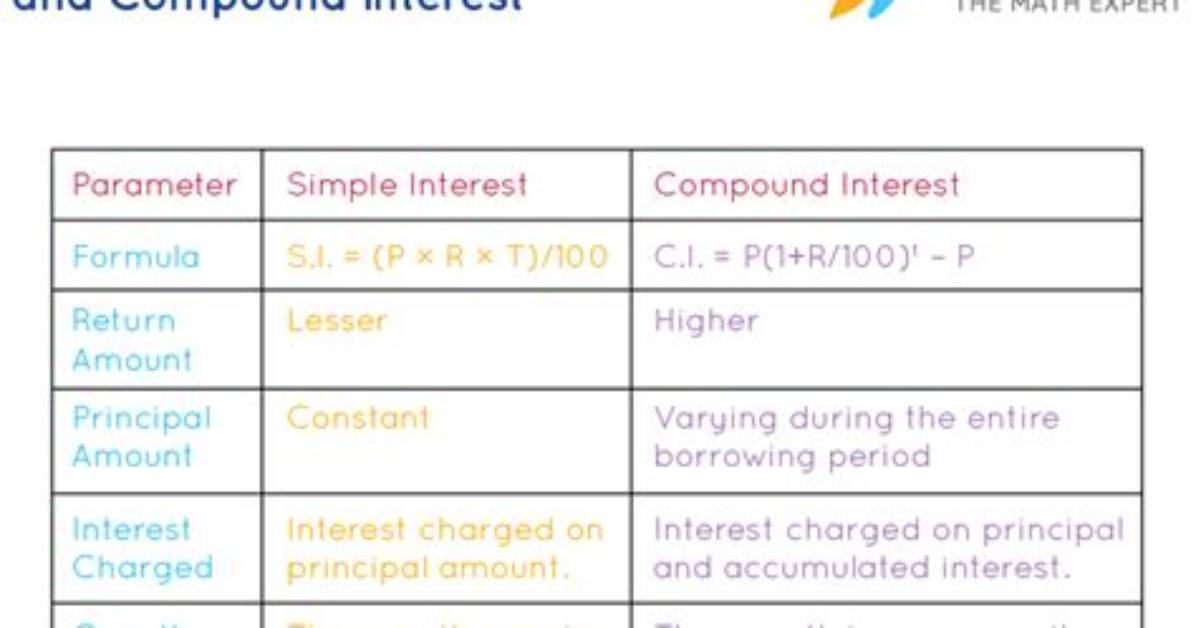
Simple interest and compound interest are two methods used to calculate the interest on a principal amount of money, but they differ in how they calculate and apply that interest. Here are the key differences between the two:
Calculation Method:
Simple Interest: Simple interest is calculated on the initial principal amount (the original sum of money) throughout the entire period of the investment or loan. The interest is calculated as a fixed percentage of the principal, usually expressed as an annual interest rate.
Compound Interest: Compound interest takes into account not only the initial principal amount but also any interest that has previously been added to the principal. It calculates interest on both the original principal and any accumulated interest over time. This means that interest can grow over time, compounding at regular intervals, such as annually, semi-annually, quarterly, or monthly.
Interest Growth:
Simple Interest: With simple interest, the interest amount remains constant throughout the investment or loan period because it's calculated only on the initial principal.
Compound Interest: Compound interest can grow significantly over time because it's calculated on both the initial principal and the accumulated interest. As a result, the interest earned or owed increases as time passes.
Formula:
- Simple Interest: The formula for calculating simple interest is straightforward:
- Simple Interest = Principal × Rate × Time
where:
Principal is the initial amount of money.
Rate is the annual interest rate (expressed as a decimal).
Time is the time period for which the interest is calculated (usually in years).
Compound Interest: The formula for calculating compound interest is more complex and involves the compounding frequency. The general formula is:
- A = P(1 + r/n)^(nt)
where:
A is the final amount, including both principal and interest.
P is the principal amount.
r is the annual interest rate (expressed as a decimal).
n is the number of times that interest is compounded per year.
t is the time period (in years) the money is invested or borrowed for.
Earnings or Costs:
Simple Interest: Typically, simple interest results in lower earnings for savings or lower costs for borrowing when compared to compound interest, as it doesn't take into account the growth of interest over time.
Compound Interest: Compound interest can result in higher earnings on investments or higher costs on loans due to the compounding effect, especially over longer periods.
In summary, simple interest is calculated only on the initial principal amount and remains constant over time, while compound interest takes into account both the principal and accumulated interest, leading to a compounding effect that can significantly impact the final amount. Compound interest tends to favor investors and lenders, while simple interest is more straightforward and favors borrowers and those with fixed-rate savings accounts.
What is Simple Interest?
Simple interest is a method of calculating interest on a loan or an investment based on a fixed percentage of the principal amount over a specified period of time. It is called "simple" because it is calculated only on the initial principal amount and does not take into account any interest that may have already accrued. In simple interest, the interest is constant throughout the entire duration of the loan or investment.
The formula for calculating simple interest is:
- Simple Interest (SI) = Principal (P) × Rate (R) × Time (T) / 100
Where:
SI is the simple interest.
P is the principal amount (the initial amount of money).
R is the annual interest rate (expressed as a percentage).
T is the time (usually in years) for which the interest is calculated.
For example, if you have a principal amount of $1,000, an annual interest rate of 5%, and the interest is calculated for 2 years, the simple interest would be:
- SI = $1,000 × 5% × 2 / 100 = $100
So, the simple interest on a $1,000 loan at a 5% annual interest rate for 2 years would be $100. This means that after 2 years, you would owe a total of $1,100, including the principal and the interest.
Must Read
What is Compound Interest?
Compound interest is a concept in finance that refers to the interest that's earned or charged not only on the initial amount of money (the principal) but also on any accumulated interest from previous periods. In other words, it's interest that compounds over time, leading to exponential growth or accumulation of wealth or debt.
Here's how compound interest works:
Initial Principal (P): This is the initial amount of money you invest or borrow.
Interest Rate (R): The interest rate is the percentage of the principal that is either earned (in the case of investments) or charged (in the case of loans) over a specific period, usually expressed annually.
Time (T): The time represents the number of periods for which interest is calculated. It can be in years, months, or any other time unit.
The formula to calculate the future value of an investment with compound interest is:
A = P(1 + r/n)^(nt)
Where:
A is the future value of the investment/loan, including both the principal and interest.
P is the initial principal amount.
r is the annual interest rate (expressed as a decimal).
n is the number of times interest is compounded per year.
t is the number of years the money is invested or borrowed for.
Compound interest can have a significant impact on the growth of savings or the increase in debt over time. The more frequently interest is compounded (higher "n"), and the longer the money is left to grow (higher "t"), the greater the impact of compound interest. This is why compound interest is often seen as a powerful force for building wealth when investing and a potential burden when dealing with debt. It allows your money to grow or your debt to increase at an accelerating rate.
Marcus Vance is a cybersecurity auditor and technology writer dedicated to educating the public about online safety, data privacy regulations, enterprise security, and emerging cyber threats.
