
Find the Area of an Isosceles Triangle Whose Two Equal Sides Measure 13 Cm and Its Base Is 24 Cm

The Correct Answer Is 60 Square Centimeters. Explanationidentifying Relevant Information: Two Sides of the Triangle Are Equal and Have a Length of 13 Cm Each...
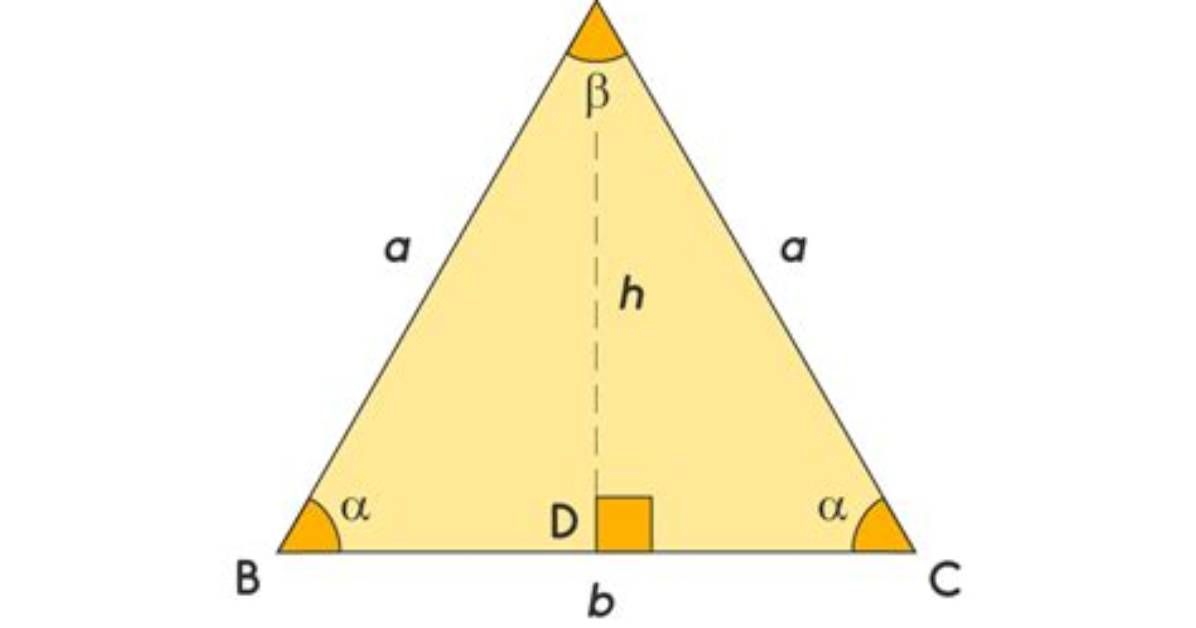
The Correct answer is 60 square centimeters.
Explanation
Identifying relevant information:
- Two sides of the triangle are equal and have a length of 13 cm each.
- The base of the triangle measures 24 cm. Using the formula for the area of a triangle: The area of a triangle can be found using the formula:
Area = 1/2 * base * height
Finding the height:
- In an isosceles triangle, the height divides the base into two equal segments. So, each segment of the base is 24 cm / 2 = 12 cm. Applying the Pythagorean theorem:
- We have a right triangle with half the base (12 cm), the height (which we need to find), and one of the equal sides (13 cm).
- Using the Pythagorean theorem:
height² = hypotenuse² - base²
height² = 13² cm² - 12² cm²
height² = 25 cm²
height = √25 cm = 5 cm
Calculating the area:
- Substitute the values into the area formula:
Area = 1/2 * base * height
Area = 1/2 * 24 cm * 5 cm
Area = 60 cm²
Therefore, the area of the isosceles triangle is 60 square centimeters.
Must Read
- What Will Be the Compound Interest on a Sum of Rs. 25,000 After 3 Year's at the Rate of 12 P. C. P. A. ?
- A Scientist Mixes 0.02 G of a Strong Base in 83 Ml of Water and Obtains a Ph of 12. He Then Realizes That He Forgot to Label the Container and Forgot What Base He Added. What Is the Most Likely the Identity of This Base?
Isosceles Triangle
An isosceles triangle is a geometric shape with two sides of equal length and two corresponding angles of equal measure. These equal sides are called legs, and the angle opposite the base is known as the vertex angle. The base of the triangle is the side between the two legs.
Because of its symmetrical properties, an isosceles triangle has some unique characteristics. For example, the altitude drawn from the vertex angle to the base bisects the base and is also the perpendicular bisector of the base. This means it splits the base into two equal segments and forms right angles with the base.
Additionally, the angles opposite the equal sides in an isosceles triangle are also equal. This property is known as the base angles theorem. Since the two legs are congruent, the base angles must be congruent as well.
Another interesting fact about isosceles triangles is that they can be dissected into two congruent right triangles by drawing a perpendicular line from the vertex angle to the base. This perpendicular line serves as the height of the triangle and splits the base into two equal parts.
David Miller brings 15 years of experience in global economics, personal finance strategy, and market dynamics. He specializes in turning complex economic trends into actionable insights for everyday readers.
