
Sum of Cubes of N Natural Numbers

The Sum of Cubes of N Natural Numbers Is a Mathematical Concept That Finds the Sum of the Cubes of the First N Natural Numbers. Learn More About the Sum of...
The sum of cubes of n natural numbers is a mathematical concept that finds the sum of the cubes of the first n natural numbers. Learn more about the sum of cubes of n natural numbers by reading below.
The sum of cubes of n natural numbers is a mathematical concept that finds the sum of the cubes of the first n natural numbers. Learn more about the sum of cubes of n natural numbers by reading below.
Image source: Fresherslive
Sum of cubes of n natural numbers
The sum of cubes of the first n natural numbers is a commonly studied problem in mathematics. It is often denoted by the symbol Σn³, where Σ is the summation notation and n is the number of terms being summed.
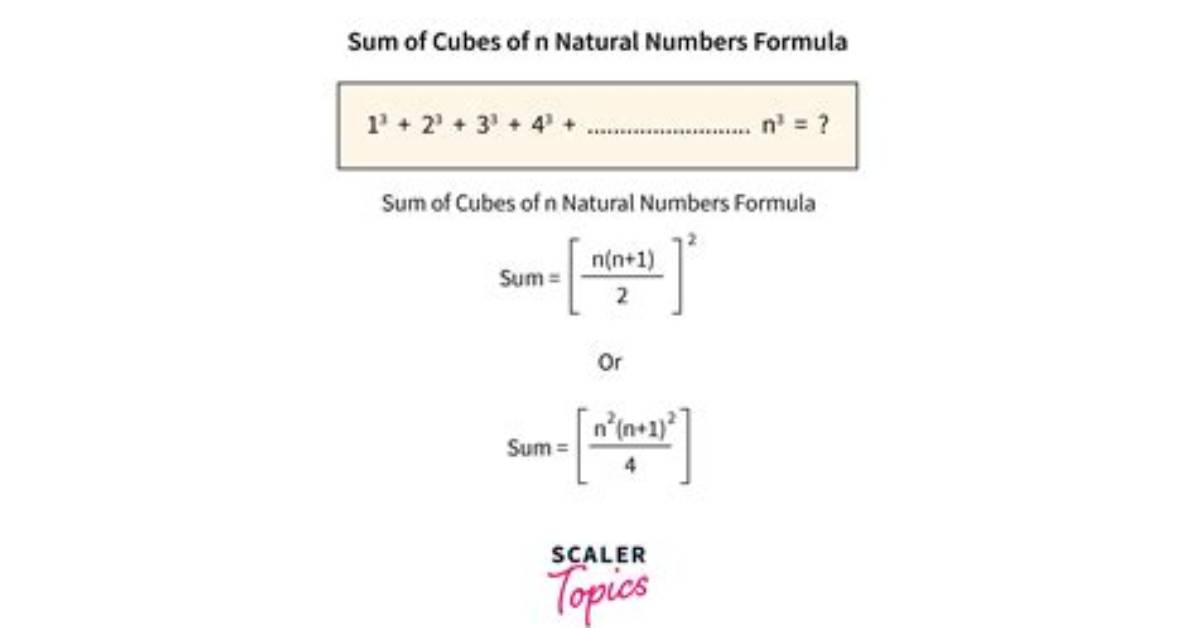
The formula for the sum of cubes of the first n natural numbers is:
Σn³ = 1³ + 2³ + 3³ + ... + n³ = (n(n+1)/2)²
To derive this formula, we can use a method called mathematical induction. The idea behind mathematical induction is to prove that a statement is true for all positive integers by first showing that it is true for the smallest positive integer (usually 1), and then showing that if it is true for some integer k, then it must also be true for the next integer k+1.
To prove that the formula is true for n=1, we simply substitute n=1 into the formula and get:
Σ1³ = 1³ = 1 = (1(1+1)/2)²
This shows that the formula is true for n=1.
Next, we assume that the formula is true for some integer k, which means:
Σk³ = 1³ + 2³ + 3³ + ... + k³ = (k(k+1)/2)²
Now, we want to show that the formula is also true for k+1, which means:
Σ(k+1)³ = 1³ + 2³ + 3³ + ... + k³ + (k+1)³
We can rewrite this expression as:
Σ(k+1)³ = Σk³ + (k+1)³
Using the formula we assumed to be true for k, we can substitute in the value of Σk³:
Σ(k+1)³ = (k(k+1)/2)² + (k+1)³
Simplifying this expression gives:
Σ(k+1)³ = [(k+1)/2]² * [(2k(k+1))/2 + (k+1)]
Σ(k+1)³ = [(k+1)/2]² * [(2k² + 3k + 1)]
Σ(k+1)³ = [(k+1)/2]² * [(k+1)(2k + 1)]
Σ(k+1)³ = [(k+1)(k+2)/2]²
This expression is exactly the formula we started with, but with n replaced by k+1. Therefore, we have shown that if the formula is true for some integer k, then it must also be true for k+1. Since we have already shown that the formula is true for n=1, we can conclude that it is true for all positive integers.
In conclusion, the sum of cubes of the first n natural numbers is given by the formula Σn³ = (n(n+1)/2)². This formula can be derived using mathematical induction, which shows that the formula is true for all positive integers.
Must Read
Sum of cubes of n natural numbers formula
The sum of cubes of the first n natural numbers is a mathematical problem that involves finding the sum of the cubes of the first n natural numbers, where n is a positive integer. This problem has a formula that can be used to quickly find the sum of the cubes of the first n natural numbers.
The formula for the sum of cubes of the first n natural numbers is:
Σn³ = 1³ + 2³ + 3³ + ... + n³ = (n(n+1)/2)²
The formula is based on the fact that the sum of the first n natural numbers is given by the formula:
Σn = 1 + 2 + 3 + ... + n = n(n+1)/2
To derive the formula for the sum of cubes of the first n natural numbers, we can use a method called mathematical induction. The idea behind mathematical induction is to prove that a statement is true for all positive integers by first showing that it is true for the smallest positive integer (usually 1), and then showing that if it is true for some integer k, then it must also be true for the next integer k+1.
To prove the formula for n=1, we can simply substitute n=1 into the formula and get:
Σ1³ = 1³ = 1 = (1(1+1)/2)²
This shows that the formula is true for n=1.
Next, we assume that the formula is true for some integer k, which means:
Σk³ = 1³ + 2³ + 3³ + ... + k³ = (k(k+1)/2)²
Now, we want to show that the formula is also true for k+1, which means:
Σ(k+1)³ = 1³ + 2³ + 3³ + ... + k³ + (k+1)³
We can rewrite this expression as:
Σ(k+1)³ = Σk³ + (k+1)³
Using the formula we assumed to be true for k, we can substitute in the value of Σk³:
Σ(k+1)³ = (k(k+1)/2)² + (k+1)³
After simplification, the expression becomes [(k+1)(k+2)/2]², which is the same as the original formula with n replaced by k+1. This shows that if the formula is valid for some integer k, it must also be valid for k+1. As we have already established that the formula holds true for n=1, we can deduce that it is true for all positive integers.
In conclusion, the formula for the sum of cubes of the first n natural numbers is Σn³ = (n(n+1)/2)². This formula can be derived using mathematical induction, which shows that the formula is true for all positive integers. The formula can be useful in many areas of mathematics and is often used in calculus and number theory.
David Miller brings 15 years of experience in global economics, personal finance strategy, and market dynamics. He specializes in turning complex economic trends into actionable insights for everyday readers.
