
Wardley Value Chain Mapping: What Is It & How to Create Yours

Strategic Plans That Support Intelligence Are Vital. Planning Ahead and Having Advanced Warning of Possible Shortcuts or Obstacles Helps Individuals and...
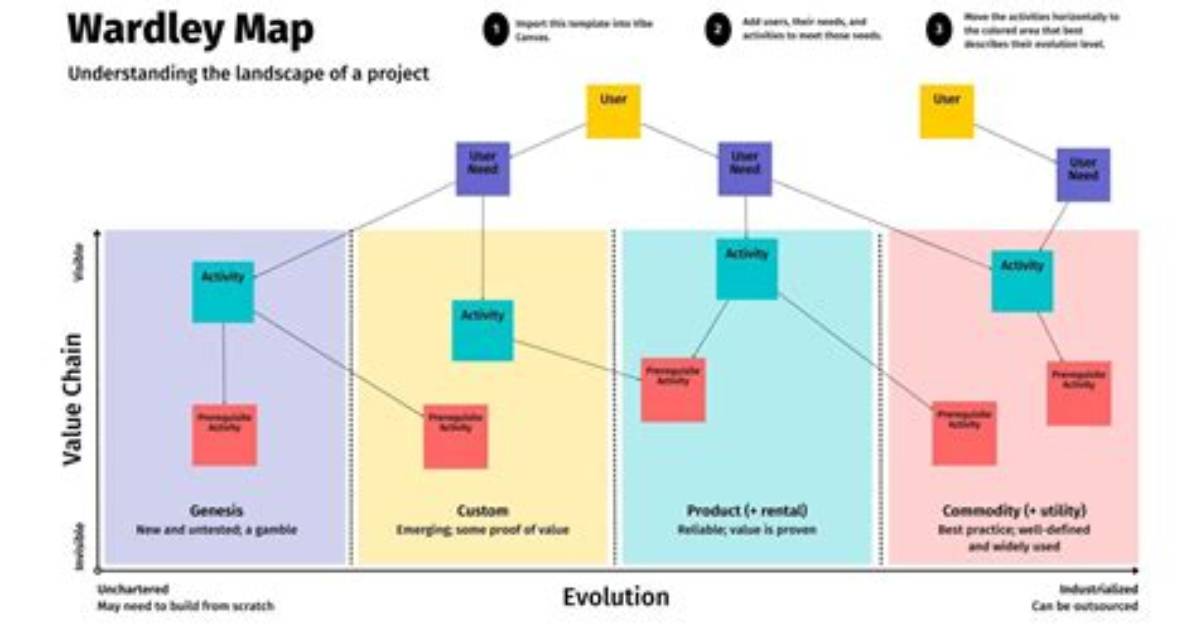
Strategic plans that support intelligence are vital. Planning ahead and having advanced warning of possible shortcuts or obstacles helps individuals and organizations navigate uncertainty with steady footing. Although some plans may look good from the outside, not all plans are as equipped as others to support through to the end.
Take, for example, hikers climbing over a mountain. They are given two options to navigate the trails: a list of directions or a map. The directions details all the obstacles on the mountain, like how many rocks and trees are in an area, but it does not show exact locations.
The map, on the other hand, shows all the major mountain locations visually with distance but does not tell the hiker how many trees they will pass. Using a map, the hiker is able to:
- Avoid sheer drops
- Clearly know their location
- Pinpoint resources like running water
- Define which route will be shorter
Trail map, Monarch Lake, Colorado (Source)
Sure, a tree may fall on a path or a rockslide may occur, but if that hiker has planned their course using a map, they can now tackle the obstacles with more ease. Using mere directions, the hiker might have to try multiple times to reroute or find resources. The choice is clear: hikers use maps for a reason.
When we apply the simple use of strategic landscape mapping to business (or any operation), it is essentially the same concept. And that concept is called Wardley Value Chain Mapping.
In this article, we’ll:
Who is Simon Wardley?
A thought leader in business with decades of experience, Simon Wardley created mapping in 2005 to
- Predict market trends
- Foresee outcomes within his organization
Today, with a focus on corporate-level IT strategies, he helps business leaders build intuitive and shareable maps that deliver several advanced operational benefits.
At the Leading Edge Form (LEF), Wardley “uses mapping in his research for the LEF covering areas from Serverless to Nation-State competition whilst also advising/teaching LEF clients on mapping, strategy, organization, and leadership.”
What is Wardley Value Chain Mapping?
Wardley value chain mapping is a way for you to:
- Visualize and examine your environment
- Identify upcoming changes
- Properly choose actions and activities
“By examining what is needed, what components will be in use, what are their dependencies and characteristics, you can build a visual representation of your world, play what-if games, and pick your direction and best actions to support it.” –GitHub
Understanding that all organizations operate within a landscape is the core of Wardley Value Chain Mapping. In business, the landscape is expressed by the value chain or independent activities needed to reach user goals. These are then set into place based on evolution and demand. The end result is a visual graphic depicting risk predictions and objectives.
Used to avoid project risk, Value Chain Maps are continual. They have an infinite level of potential. As you identify each new insight, you’ll also reveal new decision outlets. Start small and don’t worry about getting the first map right. Improvements are part of the process.
Here’s Wardley in 2014:
David Miller brings 15 years of experience in global economics, personal finance strategy, and market dynamics. He specializes in turning complex economic trends into actionable insights for everyday readers.
