
What Is Indeterminate Form (Importance, Methods and Examples)

What Is Indeterminate Form? in Mathematics, an Indeterminate Form Is a Classification of Certain Limits or Expressions That Cannot Be Immediately Evaluated...
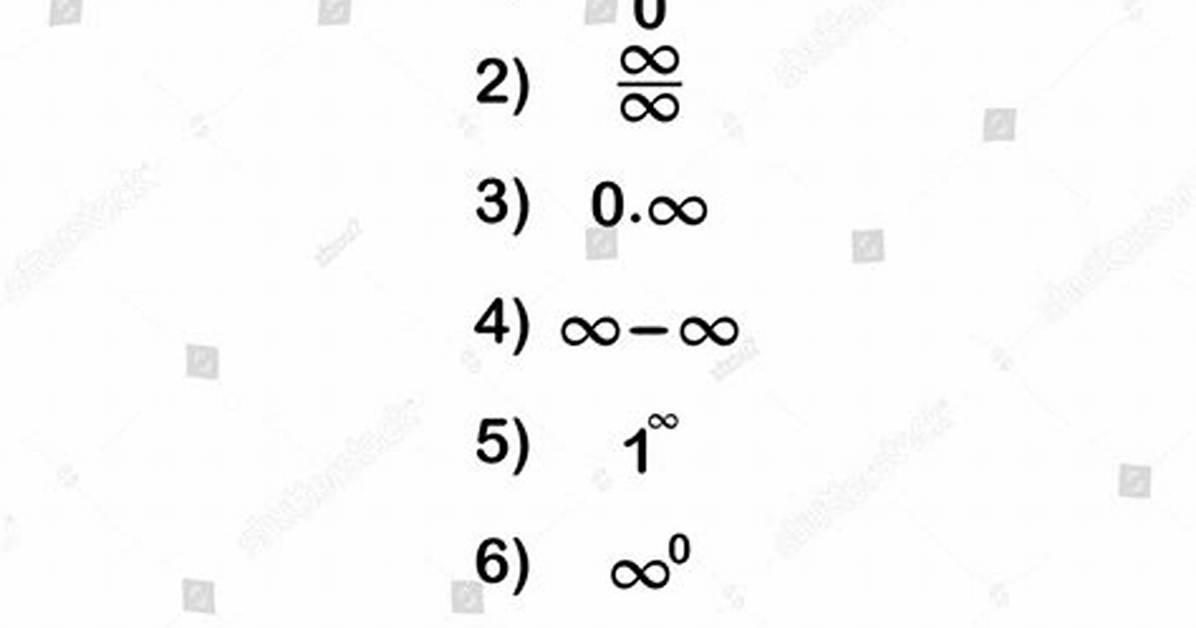
What is Indeterminate Form?
In mathematics, an indeterminate form is a classification of certain limits or expressions that cannot be immediately evaluated because they do not provide enough information to determine a unique value. These forms often arise in calculus, particularly when dealing with limits involving functions and variables that approach specific values. The term "indeterminate" signifies that the limit or expression is not definitively determined just by looking at its form, and further analysis is required to find its value.
Some common examples of indeterminate forms include:
-
0/0: This occurs when both the numerator and denominator of a fraction approach zero as a limit is taken. It does not specify whether the limit approaches a finite value, approaches infinity, or diverges.
-
∞/∞: This happens when both the numerator and denominator approach infinity. It also does not provide enough information about the behavior of the limit.
-
0^0: This indeterminate form arises when a limit involves raising zero to the power of zero. The value of this expression is not uniquely determined.
-
1^∞: When a limit involves raising one to the power of infinity, the result is indeterminate.
-
∞ - ∞: When two infinite quantities are subtracted, the result may not be immediately clear without further analysis.
To evaluate limits or expressions in indeterminate forms, various techniques and rules are employed, such as L'Hôpital's Rule, which is used for limits of the form 0/0 or ∞/∞. These techniques help determine the true value or behavior of the expression by analyzing the functions involved and their rates of change as they approach the limiting value. The result may be a finite number, infinity, or some other well-defined outcome.
Must Read
Evaluating Indeterminate Forms of Limits
Evaluating indeterminate forms of limits is a fundamental concept in calculus. Indeterminate forms occur when you attempt to evaluate the limit of a function and get a result of "0/0," "∞/∞," "0^0," "∞^0," "1^∞," or other forms that are not immediately interpretable. To find the limit in such cases, you often need to apply techniques like L'Hôpital's Rule, algebraic manipulation, or special limits. Here are some common techniques to evaluate indeterminate forms:
-
L'Hôpital's Rule: L'Hôpital's Rule is a powerful tool for evaluating indeterminate forms of limits when you have a limit of the form 0/0 or ∞/∞. It states that if you have a limit of the form:
lim (x → a) [f(x)/g(x)]
where both f(a) = 0 and g(a) = 0, or both f(a) = ±∞ and g(a) = ±∞, then the limit can be found by taking the derivative of both f(x) and g(x) and then evaluating the limit again. The process is repeated until the limit becomes determinate or approaches ∞ or -∞.
-
Algebraic Manipulation: Sometimes, you can simplify a function by algebraic manipulation to eliminate the indeterminate form. For example, factoring, canceling common factors, or expanding the expression can help in this process.
-
Special Limits: There are several common indeterminate forms for which you can use known limits:
- If you have a limit of the form 0^0, you can often rewrite the expression using exponent laws or logarithms and then apply the limit.
- A limit of the form ∞^0 or 1^∞ can often be evaluated using limits involving exponential and logarithmic functions.
- If you have a limit involving trigonometric functions, you can use trigonometric identities or special limits for trigonometric functions.
-
Squeeze Theorem: The Squeeze Theorem is useful when you have a limit of the form 0/0. It states that if you can find two other functions, g(x) and h(x), such that g(x) ≤ f(x) ≤ h(x) for all x in some interval except possibly at the point of interest, and both g(x) and h(x) have known limits as x approaches the same value, then the limit of f(x) as x approaches that value exists and is equal to the limits of g(x) and h(x).
-
Taylor Series Expansion: For some functions, you can use Taylor series expansion to rewrite the function and then evaluate the limit. This is especially useful for functions that involve transcendental functions like exponentials, logarithms, and trigonometric functions.
-
Rationalization: Rationalizing the expression by multiplying and dividing by a conjugate or using other techniques can sometimes help simplify the limit and remove the indeterminate form.
The specific technique you use depends on the form of the limit and the nature of the function you are dealing with. It's important to apply the appropriate method according to the given problem, and in some cases, a combination of techniques may be required.
Sarah Jenkins is a veteran tech journalist with over 12 years of experience covering artificial intelligence, mobile innovations, and digital ethics. Her insights have appeared in leading technology publications worldwide.
